The Illusion of Space as an Element of Recording
- Recordings create artificial spaces that don’t exist in the real world
- Spatial properties shape a track’s sound alongside timbre
- How we naturally perceive space affects how we hear recordings
- Understanding spatial properties helps us analyze what makes a recording sound the way it does
Hearing Invisible Sounds in Virtual Spaces
- Perceiving space in recordings is different from perceiving space in everyday life
- In real life we rely heavily on sight to understand space; recordings remove that
- Acousmatic listening: hearing sounds without seeing their source
- We need to train our ears to notice spatial cues in recordings
Understanding Listener Perspective
- “Point of audition”: the imaginary position from which you hear a recording
- Playback format (stereo, mono, surround) changes what spatial information is available
- Stereo is the most common format—two channels, left and right
- Each format has different strengths and limitations for spatial analysis
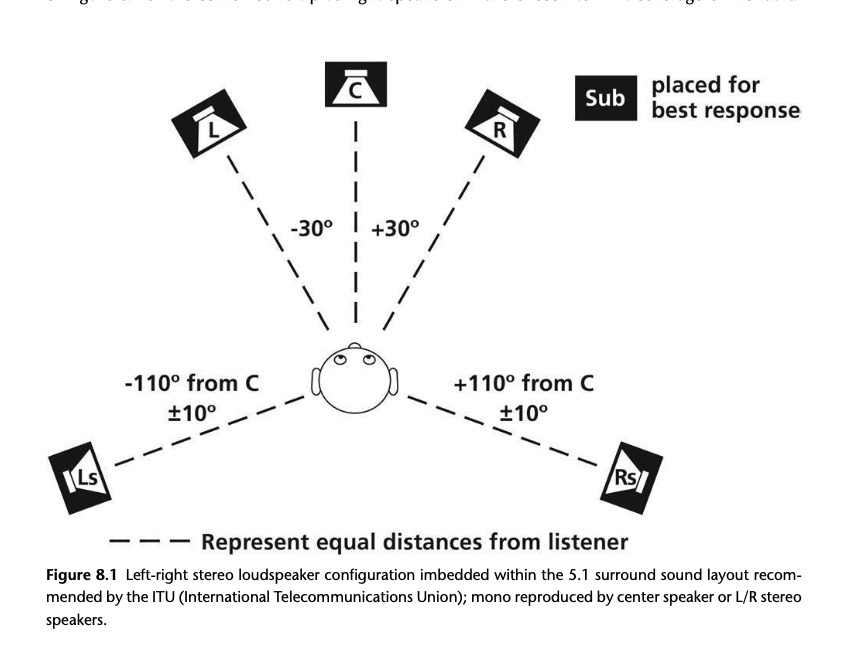
Spatial Properties
- Recordings create artificial spaces—sounds can come from “impossible” locations
- Three main illusions: direction, distance, and size of sounds
- Categories of spatial properties:
- Angular direction and width (left-right positioning)
- Distance and depth (how far away something sounds)
- Environment (the perceived room or space)
- These properties interact to create the overall spatial impression
Spatial Properties and Levels of Perspective
- Three levels of perspective:
- Individual sources: where is each sound placed?
- Composite texture: how do sources relate to each other spatially?
- Overall sound: what is the total spatial impression of the track?
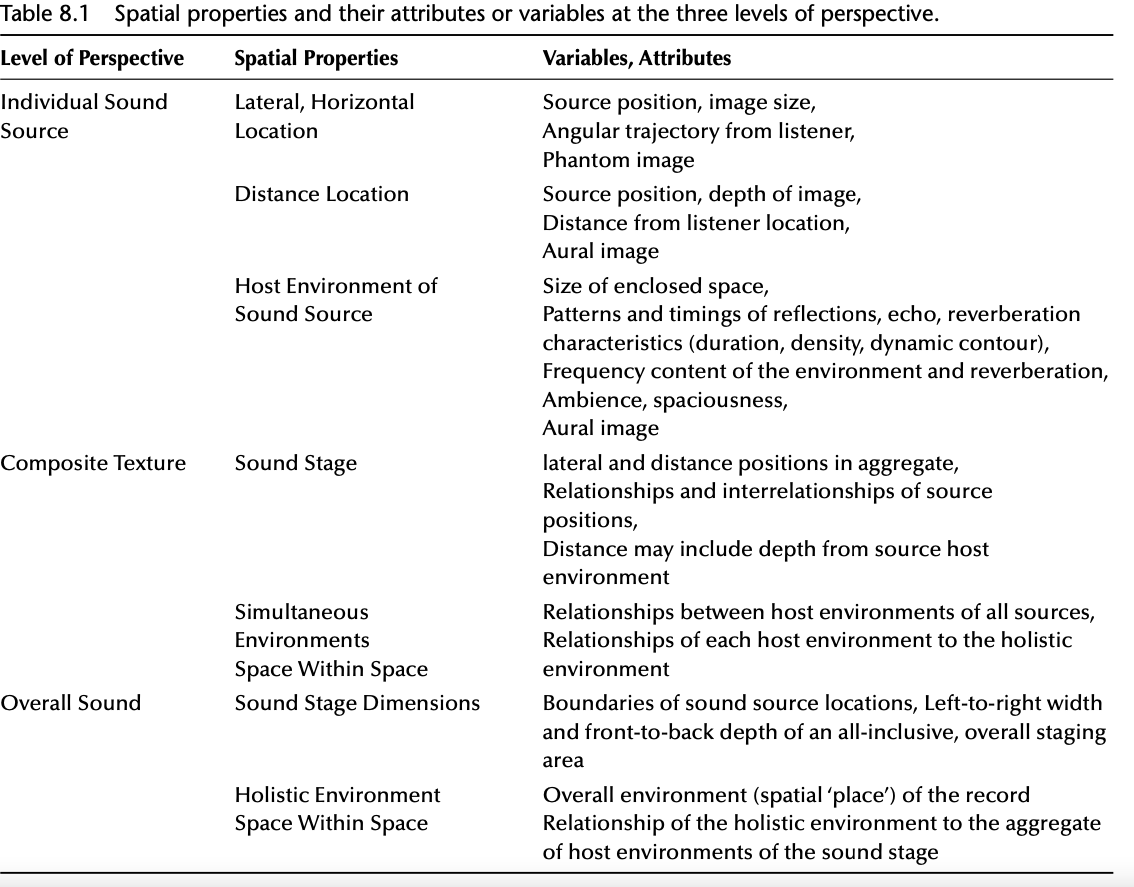
Integrating Spatial Dimensions
- How individual sound sources combine into a composite spatial texture
- Sound stage dimensions: width, depth, and distance from the listener
- Holistic environment: the total spatial world of the track
- Elevation (height) is difficult to achieve in stereo
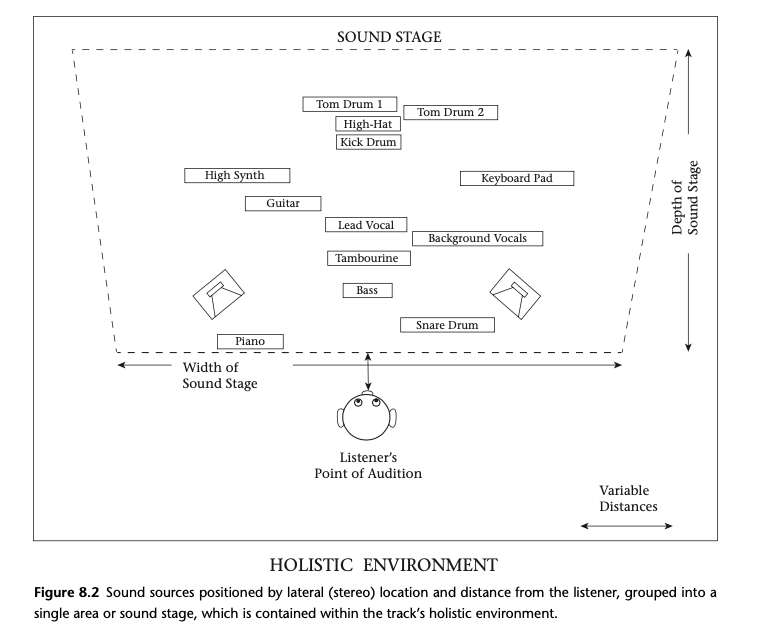
STEREO LOCATION: ANGULAR DIRECTION AND IMAGE WIDTH
- Lateral position: where a sound sits between left and right
- Stereo creates the illusion of sound coming from places where no speaker exists
- Phantom images: sounds that appear to originate between the two speakers
- The sound stage width is defined by the leftmost and rightmost sounds
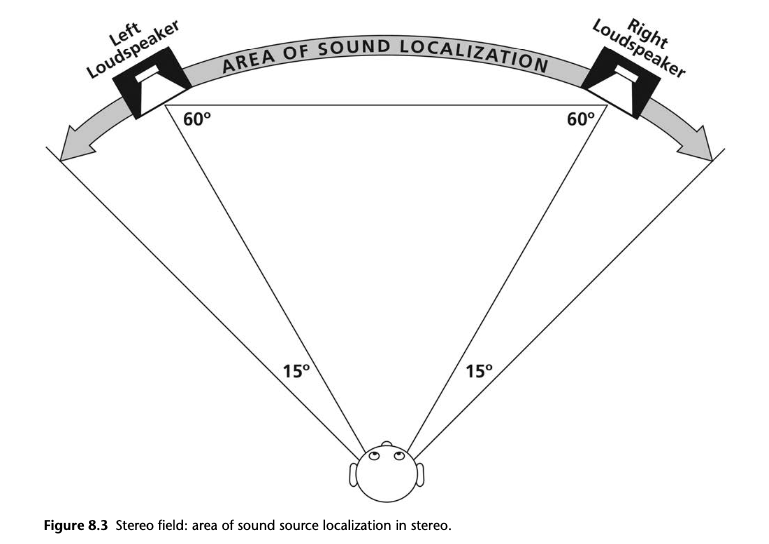
Psychoacoustics of Stereo Sound Localization
- Our brains use differences between our two ears to locate sounds
- Three key cues: timing differences (ITD), volume differences (IAD), and spectral differences (ISD)
- Higher frequencies are easier to localize than lower frequencies
- Headphones vs. speakers create different spatial experiences
Image Width
- Shifting width - Phil Collins’ “In the Air Tonight” (1981)
- Point sources - Paul Simon’s Graceland (1986)
- “Gumboots” - electric guitar sounds in the introduction
- “Crazy Love, Vol. II”
- “Under African Skies”
- Spread image - Beatles’ “She Came in Through the Bathroom Window” (Abbey Road, 1969, 1987)