
Introduction to Music Information Retrieval (MIR)
- Extracts meaningful features from music for indexing and retrieval
- Enables content-based search and recommendation systems
- Incorporates user behavior and preferences into models
- Recognizes the multimodal nature of music
Evolution and Growth of MIR
- Emerged in the last two decades
- Driven by audio compression, computing power, and mobile music players
- Expanded with music streaming services
- Shifted from symbolic representations (MIDI) to direct audio signal processing
Key Applications of MIR
- Music retrieval through similarity-based search
- Computational music theory and comparative analysis
- Music creation via “audio mosaicing”
- Enhancing expert knowledge with large datasets
Challenges and Future Directions
- Understanding user preferences and behavior
- Developing high-level music descriptors
- Expanding research beyond Western music traditions
- Building scalable, robust MIR systems
The Future of MIR
- Personalized music recommendation systems
- Integration of multiple sensory modalities
- Considering technological, social, and cultural perspectives
- Potential for AI-driven musical companionship
Audio Content Analysis
Music Feature Extraction in MIR
- Extracts meaningful characteristics (descriptors) from music
- Features classified by abstraction level, temporal scope, and musical facet
- Low-level features describe signal properties like timbre and energy
- High-level features represent musical elements like melody and harmony
Low-Level Music Features
- Derived directly from the audio signal, mainly in the frequency domain
- Represent timbre, loudness, and spectral properties
- Examples: Zero Crossing Rate, MFCCs, spectral moments
- Used for timbre representation and audio fingerprinting
High-Level Music Features
- Semantically meaningful descriptors inferred from low-level features
- Melody features derived from pitch content and periodicity
- Harmony features include chroma representation of tonal structure
- Rhythm features analyze timing, tempo, and meter patterns
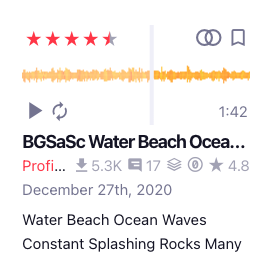
Find Similar Sounds with Freesound
Signal Processing in MIR
- Fundamental for analyzing audio signals and extracting features
- Two main approaches: time-domain and frequency-domain analysis
- Time-domain captures amplitude changes over time
- Frequency-domain reveals spectral content and pitch information
Time-Domain Analysis
- Represents audio signals as amplitude over time
- Extracts low-level features like Zero Crossing Rate and RMS energy
- Identifies transients and note onsets through waveform analysis
- Useful for loudness, attack time, and rhythmic structure analysis
ex: Essentia.js
ex: Mel-spectrogram
Frequency-Domain Analysis
- Uses Fourier Transform to represent signals in the frequency domain
- Short-Time Fourier Transform (STFT) provides time-varying spectral analysis
- Extracts features like spectral moments, MFCCs, and chroma features
- Essential for timbre description, pitch estimation, and tonality analysis
ex: Chroma
Machine Learning in MIR
- Infers high-level musical information from extracted features
- Classification and auto-tagging predict genres, instruments, and moods
- Deep learning models (CNNs) enhance music recognition tasks
- HMMs, GMMs, and SVMs assist in segmentation and pattern recognition
Musical Structure Analysis
Segmentation
- Divides an audio stream into homogeneous sections
- Used in speech/music separation, note identification, and structure analysis
- Methods include model-free (feature change detection) and model-based (trained probabilistic models)
- Related to onset detection, novelty detection, and music structure analysis
ex: Audio Slicer
Pattern Recognition
- Identifies motifs, chords, and melodies in music
- Uses self-similarity analysis and novelty detection for motif detection
- Chord recognition relies on chroma features, templates, and probabilistic models
- Melody extraction applies f₀ estimation and source separation techniques
See: Music21 or Sonic Visualiser or Musipedia
Music Metadata
Descriptive Metadata
- Categorizes music using title, artist, album, genre, and style
- Genre classification models music based on content and context
- Auto-tagging assigns semantic labels from user-generated data
- Used in music retrieval, recommendation, and indexing systems
See: MusicBrainz or Discogs
Semantic Metadata
- Describes music’s meaning and expressive content (lyrics, mood, instrumentation)
- Lyrics provide textual context and influence perception
- Mood and emotion recognition classify expressive intent
- Instrumentation helps define timbre, genre, and music content
See: Musixmatch
Music Retrieval Systems
Query-by-Example
- Uses an audio sample to retrieve similar music
- Similarity measured locally (within excerpts) or globally (between pieces)
- Humming or singing can serve as a query input
- Commercial systems (e.g., SoundHound) match queries to a database
ex: SoundHound Music free ex: Real-time music autotagging
Query-by-Text
- Uses keywords, semantic tags, or lyrics to retrieve music
- Semantic search engines fuse metadata with audio features
- Tag-based retrieval assigns descriptive labels (e.g., mood, genre)
- Lyric search models the contextual and multimodal aspects of music
ex: Spotify, Apple Music, etc.
Music Recommendation Systems
Collaborative Filtering
- Uses user preferences or item similarity to generate recommendations
- User-based filtering recommends music based on similar users’ tastes
- Item-based filtering recommends based on similarity between songs
- Explicit (likes, ratings) and implicit (skips, listening history) feedback shape recommendations
ex: Spotify
Content-Based Filtering & Hybrid Systems
- Content-based filtering analyzes music features for recommendations
- Uses low-level (timbre, rhythm) and high-level (genre, mood) features
- Hybrid systems combine collaborative and content-based methods
- Context-aware systems factor in location, time, and user state
ex: Pandora
Music Classification
- Genre classification uses machine learning to assign genre labels
- Features like timbre, rhythm, and harmony aid classification
- Mood classification analyzes emotional content using semantic labels
- Machine learning models (e.g., SVM, kNN) improve classification accuracy
ex Genre Classifier ex: Mood Classifier
Music Clustering
- Groups music based on similarity in audio features or user interactions
- Similarity-based clustering analyzes feature vectors from audio content
- User-generated clustering uses collaborative tags and playlist data
- Supports visualization tools and personalized recommendation systems
Music Creation Tools
- AI-driven systems generate new music compositions
- Udio, Jukedeck
- Recurrent Neural Networks (RNNs) and Generative Adversarial Networks (GANs) used for music generation
- Audio mosaicing substitutes musical fragments to create novel pieces
Music browsing/playlists
- MIR enables automatic playlist generation and music browsing interfaces
- Songrium - AI-driven music recommendation platform
- Every noise at once - Music genre map visualization
More Projects at Freesound Labs