Listen: where is the sound?
Two B-format recordings by John Leonard:
Which directions felt clear? Where were you uncertain?
What you should be able to explain
- What ambisonic channels represent.
- Where encoding, transformation, and decoding belong.
- Why two four-channel files may need a format conversion.
- What changes when we change the playback system.
The production signal path
- Capture or encode a sound field.
- Transform the field, such as rotating it.
- Decode it for headphones or a speaker layout.
Keep an ambisonic master so you can make different playback versions.
Why separate the field from the speakers?
- Developed in the 1970s by Gerzon, Craven, Fellgett, and others.
- Recordings store sound-field components.
- Decoders turn those components into playback channels.
- One ambisonic master can serve different listening systems.
Two ways into the field
- An ambisonic microphone captures a scene, including its ambience.
- An encoder places a mono source at a chosen direction in the field.
We could record the whole environment or combine an ambience recording with a separately encoded bird call.
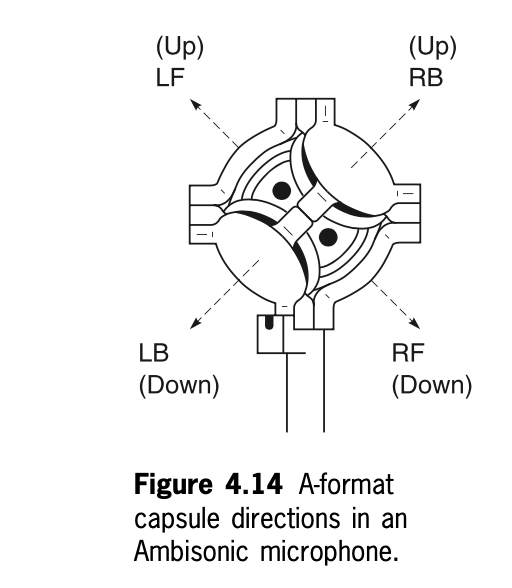
Four raw signals from a tetrahedral microphone.
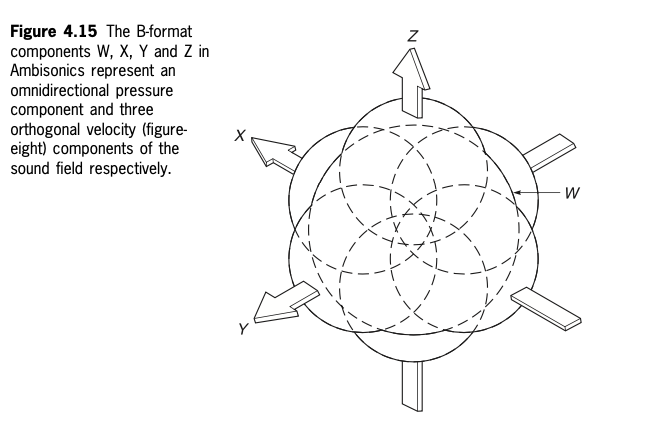
W: omni. X: front/back. Y: left/right. Z: up/down.
Predict the components
Imagine one source directly in front of the microphone, at ear height.
- Moving front to back: which component reverses polarity?
- Moving above to below: which component changes?
- Compare predictions with a partner.
| A-format | First-order B-format |
|---|
| Signals represent | Microphone capsules | Field components |
| Channels | Four for this array | Four for full-sphere FOA |
| Next step | Mic-specific conversion | Transform or decode |
Both have four channels. Their meanings differ.
FuMa and AmbiX
Both can represent first-order B-format.
- FuMa: W, X, Y, Z channel order, with FuMa scaling.
- AmbiX: ACN order and SN3D scaling. At first order: W, Y, Z, X.
The file and processor must agree on order and scaling.
Rotating our scene
Rotate the whole field by a quarter turn.
- Where do the bird and traffic move?
- Does their separation change?
- Could this move only the bird?
Decoding for the listener
- A binaural decoder produces headphone signals.
- A loudspeaker decoder produces feeds for a specified array.
What happens to height reproduction if all the speakers are at ear level?
Higher order: more spatial detail
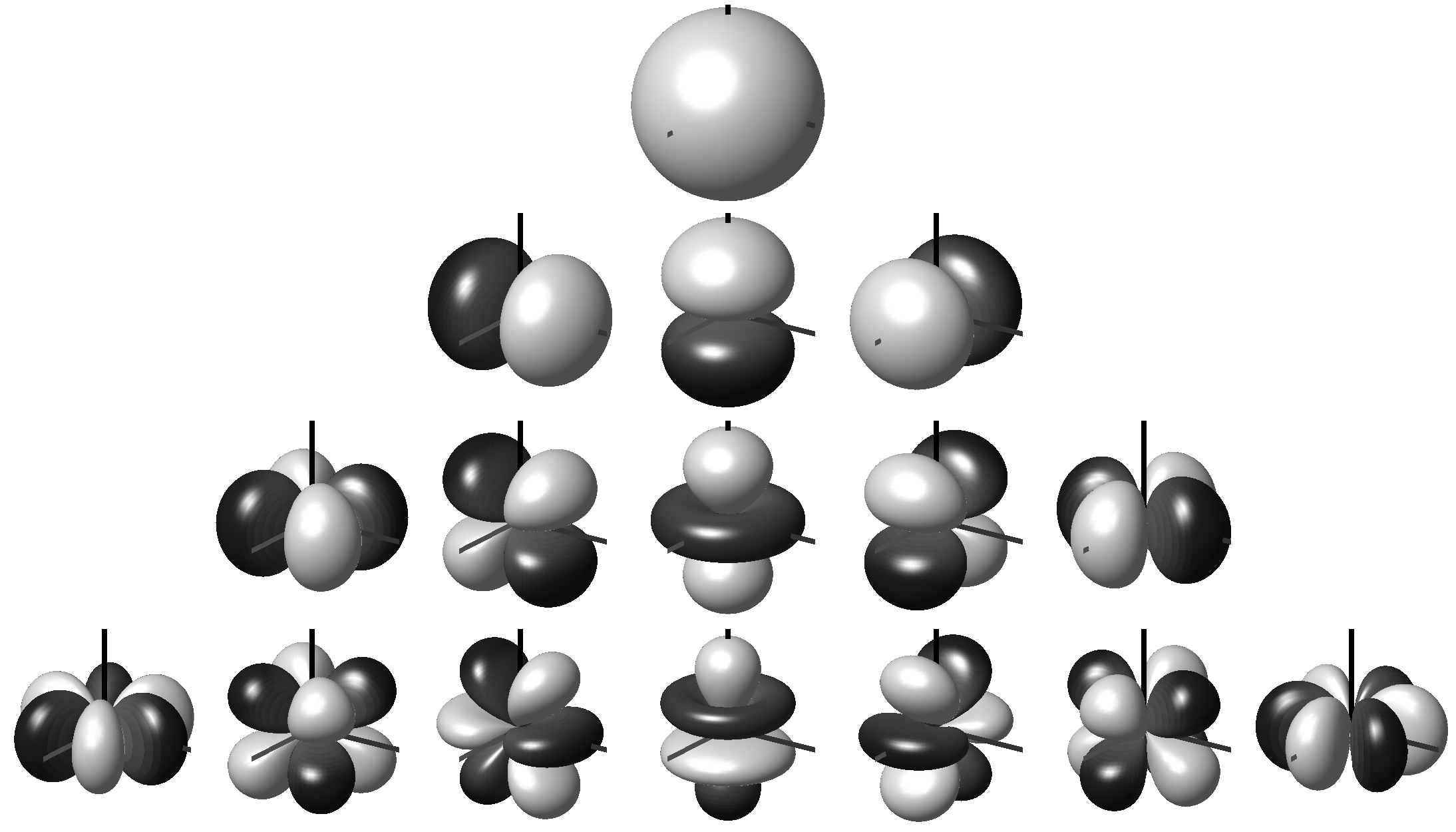
Full-sphere channels: first order 4, second order 9, third order 16.
Ambience and individual sounds
- A recorded field can provide surrounding ambience.
- A separate bird source can move independently.
Which approach would you choose for a player-controlled vehicle, and why?
Find the problems
This workflow contains deliberate mistakes. What would you change?
- Combine a raw mono bird call with four-channel AmbiX ambience.
- Decode the result to binaural stereo.
- Put a FuMa field-rotation processor after the decoder.
- Save only the binaural stereo file, then try to use it to create a 7.1 mix.
With a partner, identify what needs changing and explain why.
Check the signal path
Available sources and processors:
- Mono bird call and AmbiX ambience.
- FuMa field-rotation processor.
- Binaural decoder expecting FuMa.
Sketch the combined path for headphones. Mark the format conversion and where to save a master for speaker playback.