Spatial audio psychoacoustics
Direction, listening, and spatial impression
From distance to direction
- Wednesday: make a mono source approach and recede
- Today: explain left/right and front/back impressions
- Next: use those observations in stereo and binaural work
Listening setup
- Wear headphones with left and right correctly placed
- Use a comfortable level and pause between examples
- Turn off added spatial processing for cue-isolation demos
Report what you hear, including uncertainty.
Two differences between the ears
- ITD: interaural time difference
- ILD: interaural level difference
For a source on your right, which ear usually receives it first?
Interaural time difference
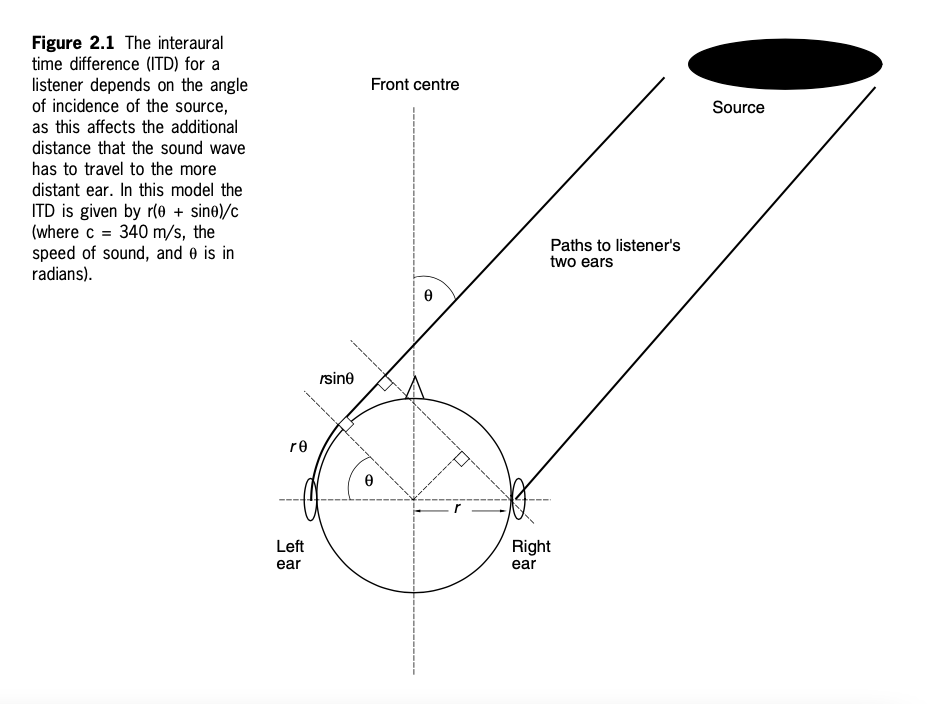
Listen: timing alone
Predict the direction, then describe the shift.
Does the sound sit inside your head or outside it?
Interaural level difference
- The head creates a frequency-dependent acoustic shadow
- The far ear usually receives less high-frequency energy
- Longer wavelengths diffract around the head more readily
ILD compares levels at the two ears.
Listen: level difference
Open the ISLE level-difference experiment
- Select the level-difference cue
- Compare a centered image with unequal ear levels
- Keep frequency and timing fixed
Frequency changes cue usefulness
- Low-frequency timing is useful for left/right judgments
- High-frequency level differences often contribute strongly
- Onsets and envelopes can also carry timing information
These are tendencies, not an absolute frequency split.
A timing ambiguity
A source in front and a source behind can produce similar ITD and ILD.
What additional information could distinguish them?
Pinnae and spectral cues
The outer ear filters sound differently for different directions.
Patterns of peaks and notches help distinguish elevation and front from back.
An HRTF describes the acoustic filtering from a source to one ear.
A left/right pair captures timing, level, and spectral differences for a source position.
Compare three HRTFs
Which gives the clearest position or strongest outside-the-head impression?
What the comparison tells us
- A shared render can produce different impressions
- Clear direction and externalization are separate judgments
- A preferred sample is a starting point for further testing
Head movement adds evidence
With a real, stationary sound source, turn your head gently.
How do direction and timbre change?
A fixed headphone file usually moves with your head.
First arrivals and reflections
A direct sound may be followed by similar reflected sound.
We often hear one event located toward the first arrival.
This is the precedence effect.
Following one voice
Choose a voice to follow. What helps you keep track of it?
Seeing can influence hearing
A visible speaker can pull the apparent location of a voice.
Listen once without the picture, then compare with it.
What changed in your judgment?
Apparent source width
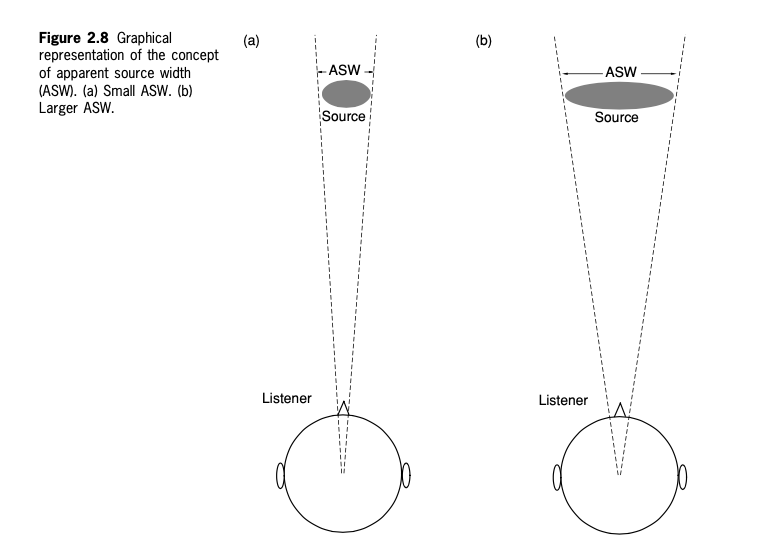
Source and space
- Source width: how broad the source seems
- Envelopment: how surrounded by sound you feel
- Externalization: whether sound seems outside your head
One can change without the others.
Believable spatial sound
- Position and movement support the scene
- Timbre stays plausible as the source moves
- The source and room seem to belong together
Describe the evidence behind “natural.”
Design a spatial scene
A close voice, a moving object, and a surrounding environment.
Choose which should be precise, broad, or enveloping.
What listening test would check your choice?
Exit check
- What differs between ITD and ILD?
- Why can an HRTF work differently for two listeners?
- Can a wide sound still feel inside your head?
Optional timing comparisons
500 Hz and 2 kHz phase comparison, 13 seconds Does changing the stimulus change the spatial impression?
Three more HRTFs
Compare with your preferred sample from A–C.
Timing model: optional detail
ITD ≈ r(θ + sin θ) / c
- r is head radius, not ear-to-ear distance
- θ is azimuth in radians, from front toward the side
- c is the speed of sound
This is a simplified spherical-head model.
Two different timing relationships
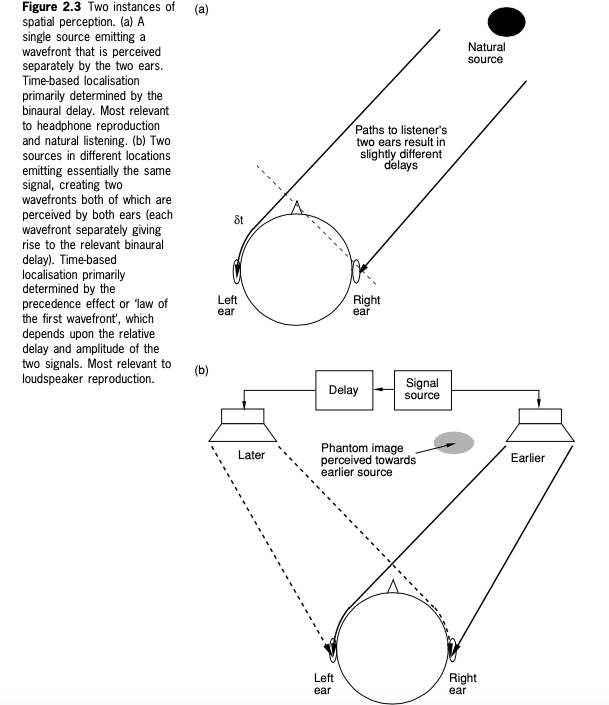
Another speech comparison
Separate and combined speech, 23 seconds Which voice can you follow, and which cue helps?
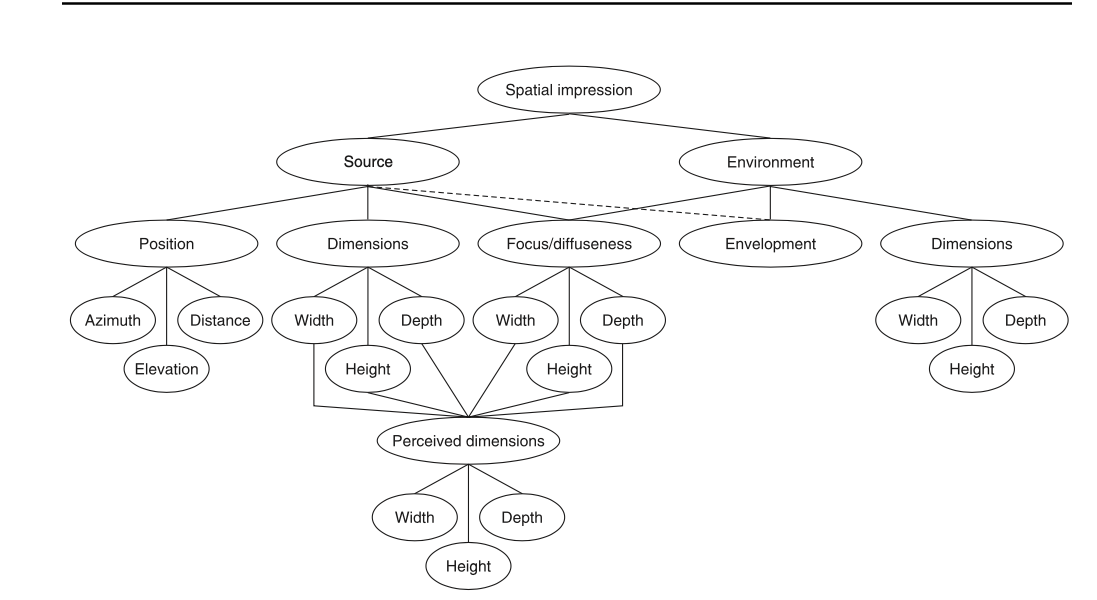
Spatial impression: reference map