Oscillation and Vibration

Oscillation

  • Repetitive back-and-forth motion around a reference point

Vibration

  • A specific physical form of oscillation
  • Typically involves a mass moving around its equilibrium
  • A fundamental source of sound when that equilibrium is disturbed

Simple Harmonic Motion (SHM)

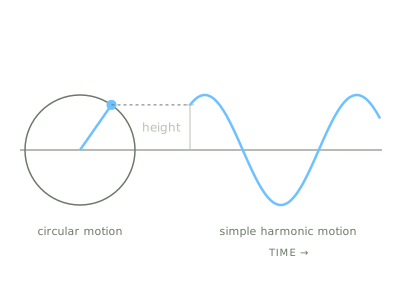
A point moving around a circle at constant speed, with its vertical height traced out to the right as a sine wave.
  • Restoring force proportional to displacement (Hooke’s Law)
  • Described by a sinusoidal function
  • Defined by amplitude, frequency (or period), and phase
  • Sine waves are the purest form of sound, and build every complex one

Play with it: circular motion → SHM · mass on a spring · SHM visualizer

Complex Vibrations

  • Real acoustic signals are rarely pure sine waves
  • Comprised of multiple SHMs summed together
  • Complex waveforms define timbre and texture

Interactive audio demo — requires JavaScript.

Amplitude and the Signal Envelope

Concepts

  • Amplitude: peak height; correlates with loudness
  • Envelope: the outline of amplitude over time
  • Attack → Decay → Sustain → Release

Design an envelope

Interactive audio demo — requires JavaScript.

Period and Frequency

Period

  • Time for one complete oscillation (T)

Frequency

  • Number of cycles per second (Hz); frequency = 1 / period

Interactive audio demo — requires JavaScript.

Frequency and Period Conversion

Frequency (f)

Period (T)

Phase

Concept

  • Describes the position within a cycle (degrees or radians)
  • Two waves with same frequency and amplitude but different phase can behave differently together

Impact

  • Asynchronous phase shifts may be imperceptible
  • Simultaneous multi-source phase relationships affect loudness, timbre, and spatial cues

Logarithmic Scales in Acoustics

Why Logarithmic?

  • Human perception of stimulus is proportional to logarithm of intensity (Fechner’s Law)
  • Compresses wide dynamic ranges into manageable scales

Applications

  • Express acoustic quantities (power, intensity, pressure) in decibels (dB)
  • Aligns measurement scale with human hearing sensitivity

Common Sound Levels

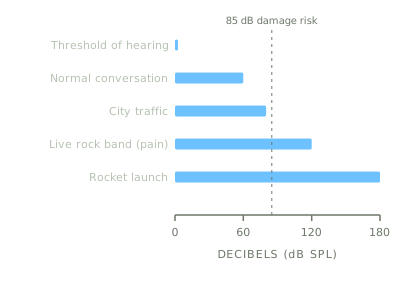
A decibel scale from 0 to 180 dB, marking the threshold of hearing, normal conversation, a live rock band at the pain threshold, and a rocket launch.
  • ~180 dB – Rocket launch (irreversible hearing loss)
  • ~120 dB – Live rock band (pain threshold)
  • ~60 dB – Normal conversation
  • ~0 dB – Threshold of hearing

RMS Amplitude

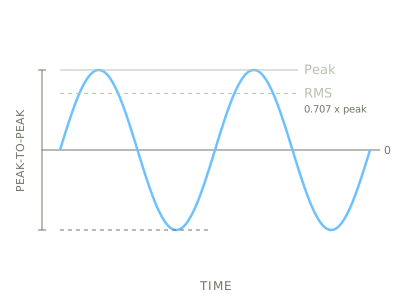
A sine wave with its peak amplitude, its RMS amplitude at 0.707 of the peak, and its peak-to-peak amplitude marked.
  • RMS measures the energy of an oscillating signal
  • Squaring the signal makes positive and negative deflections both count toward the average
  • Tracks perceived loudness far better than peak level does

Superposition and Interference

  • Superposition: multiple waves add algebraically to produce a complex resultant
  • Interference: constructive amplifies, destructive cancels
  • Beats arise from near-frequency waves (fluctuating amplitude)

Interactive audio demo — requires JavaScript.