Course overview
- We’ll begin with acoustics and psychoacoustics because binaural audio, ambisonics, and Dolby Atmos all depend on how sound behaves and how we perceive it.
- Over the semester, we’ll work with stereo, binaural audio, ambisonics, 5.1, and Dolby Atmos.
- Today’s class ends with a listening session that compares these formats.
Fundamentals of sound

How you locate a sound
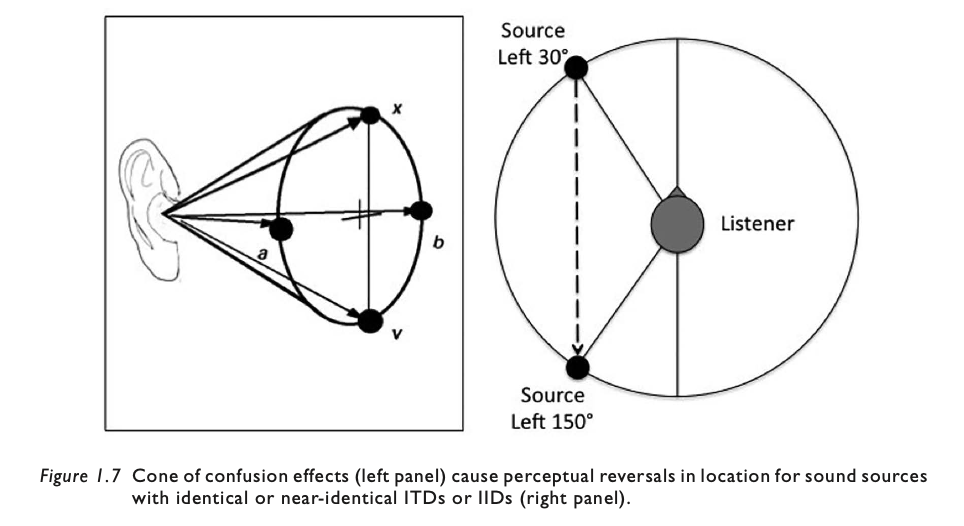
- According to Rayleigh’s duplex theory from 1907, interaural time differences help us locate low frequencies, while interaural level differences help us locate high frequencies.
- The maximum time difference across a human head is about 650 microseconds.
- The head shadow depends on frequency. For a sound 90 degrees to one side, the shadow measures about 10 dB at 3 kHz, 20 dB at 6 kHz, and 35 dB at 10 kHz. Below roughly 2 kHz, sound waves bend around the head and weaken this cue. That is why hearing relies on both time and level differences.
How you judge distance
- In a free field, the sound level falls by 6 dB each time the distance doubles. To make a sound seem half as far away, however, its level must increase by about 10 dB.
- Indoors, the strongest cue is the ratio of reverberant to direct sound.
- Familiar sounds can override these cues. A shout tends to sound far away, while a whisper tends to sound close, regardless of playback level.
Immersive audio technologies
Listening session
- We’ll listen to some 5.1 mixes with the time we have left.
Source
The localization and distance material comes from Elizabeth Wenzel, Durand Begault, and Martine Godfroy-Cooper, “Perception of Spatial Sound,” ch. 1 of Agnieszka Roginska and Paul Geluso, eds., Immersive Sound (Routledge, 2017).