Psychoacoustics & Digital Audio
How human perception and digital systems shape forensic audio analysis
Roadmap
- Psychoacoustics for Forensic Listening
- Masking, critical bands, loudness, temporal limits, spatial cues
- Digital Audio Through a Perceptual Lens
- Sampling, codecs, artifacts, perceptual vs. signal evidence
- Applied Forensic Context
- When perception matters, courtroom implications, best practices
I. Psychoacoustics for Forensic Listening
Understanding the human auditory system’s capabilities and limitations
Why Psychoacoustics Matters in Forensics
- Earwitness reliability: Can a witness have physically heard what they claim?
- Enhancement assessment: Does “clearer” audio actually improve intelligibility?
- Codec artifact identification: Is that noise original or introduced by compression?
- Expert testimony: How do you explain perceptual limits to a jury?
Auditory Masking: Overview
Definition: One sound (masker) raises the threshold of hearing for another sound (probe/maskee), potentially making it inaudible
Three types critical for forensics:
- Simultaneous (spectral) masking
- Temporal masking (pre- and post-masking)
- Informational masking
Simultaneous (Spectral) Masking

Simultaneous masking curves illustrating upward spread of masking
- Mechanism: Cochlear overlap—strong sound creates peak on basilar membrane that "drowns out" weaker nearby signals
- Upward spread of masking: Low frequencies mask high frequencies much more effectively than the reverse
- Critical bands: Masking strongest within auditory filter bandwidths
- Thresholds: Tonal masker needs ~14.5 dB SMR to hide noise; noise masker needs only ~5 dB to hide tone
Temporal Masking
Pre-masking (backward masking):
- Sound masked even if it occurs before the masker
- Brain processes louder signal faster, “catches up” to weaker signal
- Time window: 5–20 ms
Post-masking (forward masking):
- Sound masked for duration after masker stops
- Caused by basilar membrane “ringing” and neural recovery time
- Time window: 100–200 ms (up to 500 ms for some effects)
Informational Masking
Not energetic overlap—higher-level perceptual interference
- Occurs in central nervous system, not cochlea
- Caused by:
- Similarity between target and masker
- Attention limitations
- Auditory Scene Analysis (ASA) failures
- Example: “Cocktail party effect”—brain can’t separate voices even when physically distinguishable
Forensic Masking: Key Questions
When analyzing audio evidence, ask:
- Could the witness have heard this given the noise floor?
- Is “inaudible” speech actually below the masking threshold, or just quiet?
- Has lossy compression masked subtle background evidence?
- Would enhancement shift the masking relationship and make inaudible sounds audible?
Critical Bands and Auditory Filters

- Physiological basis: Basilar membrane is narrow/stiff at base (high freq), wide/flexible at apex (low freq)
- Tonotopic organization: Spatial frequency mapping—different locations code different frequencies
- Critical bands: Overlapping bandpass filters; within a band, ear integrates energy as single unit
- Bandwidth changes: ~100 Hz constant below 500 Hz; above 500 Hz, ~20% of center frequency
Perceptual Frequency Scales
| Scale | Basis | Primary Forensic Use |
|---|---|---|
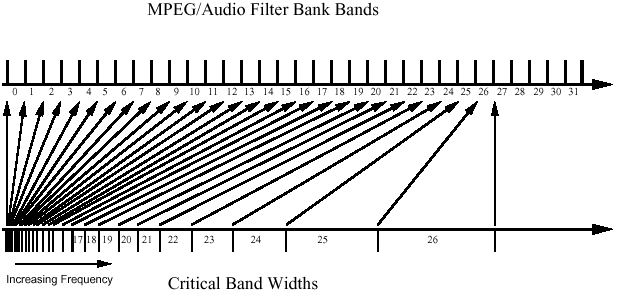
| Bark Scale | 24 critical bands; 1 Bark = 1 critical band | Audio compression (MP3 standard); loudness modeling |
| Mel Scale | Pitch perception; 1000 mels = 1000 Hz at 40 dB SPL | Speech recognition; speaker identification (MFCCs) |
| ERB Scale | Equivalent Rectangular Bandwidth; smoother auditory filter refinement | Noise reduction algorithms; high-resolution psychoacoustic research |
Equal-Loudness Contours (ISO 226)

- Phon: Loudness level; 1 phon = 1 dB SPL at 1 kHz
- Sone: Subjective loudness; 1 sone = 40 phons; +10 phons = ×2 sones
- Most sensitive: 2–5 kHz (ear canal resonance)
- Least sensitive: Below 100 Hz and above 10 kHz
- Level dependency: Curves flatten at high volumes—response more consistent across frequencies
Forensic Implications: Equal-Loudness
Gain normalization & playback
- Audio sounds "thin" at low volumes—bass and treble fall below threshold before midrange
- AGC or compression used to normalize levels for court playback
- Caution: excessive normalization can obscure spatial cues (distance, orientation)
A-weighting
- Standard sound level measurements use A-weighting (inverse of 40-phon curve)
- Reflects how environmental noise actually impacts human listeners
Codec artifacts
- Lossy formats exploit equal-loudness to hide quantization noise in less-sensitive bands
- "Birdie noise" or artifacts in these bands can be misinterpreted as original evidence
Temporal Resolution and Transients
Loudness integration window: ~200 ms
- Ear integrates sound energy over ~200 ms
- Brief sounds shorter than this may seem quieter than actual SPL
Temporal fusion and pitch: ~30 ms
- Integration window for pitch perception and timbral fusion
- Sounds separated by <30 ms may fuse into single event
Transient detection thresholds
- Muzzle blast: 1–3 ms
- Ballistic shock wave: hundreds of μs
- Minimum detectable discontinuity: ~2 ms cross-fade can conceal clicks from listeners (but not spectral analysis)
Micro-Edit Detection
Butt splice
- Abrupt deletion or insertion
- Creates vertical line across spectrogram (broadband energy)
- Audible click if during loud passage; visual if during silence
Cross-fade
- ~2 ms blend smooths samples and eliminates click
- Background-consistency analysis can still reveal edits
Background forensics
- Reverb gaps: inserting “dry” speech into a reverberant recording leaves an unnatural gap in the reverberant tail
- Background shifts: abrupt changes in noise texture or disappearance of continuous tones (e.g., 60 Hz hum)
Spatial Hearing and Localization
Interaural Time Difference (ITD)
- Difference in arrival time between ears
- Max ITD: ~0.6 ms (sufficient for full lateral displacement)
- Most effective below 1.5 kHz (fine-structure phase sensitivity)
Interaural Level Difference (ILD/IAD)
- Head shadowing reduces intensity at the far ear
- ILD of 10–20 dB moves auditory image to one side
- Dominant above 1 kHz (wavelength small relative to head)
Cone of confusion
- Locations with identical ITD and ILD → ambiguous (front/back, above/below)
- Resolved by spectral cues from pinna (directional bands, notches 5–10 kHz)
Precedence Effect (Haas Effect)
Law of the first wavefront
- First sound to reach the ear dominates localization perception
Time windows: 1–30 ms
- If reflection arrives within this window, brain fuses it with direct sound
- Localization set by first arrival, even if reflection is up to 10 dB louder
Forensic implication
- Shooter location determined by direct path, even if wall reflections are energetic
- Multilateration uses measured TDOA (time difference of arrival), not perceived location
Stereo Artifacts from Tampering
Talker discontinuity
- Abrupt changes in perceived level or orientation without logical movement
Reverberant mismatches
- "Dry" recording inserted into reverberant original lacks reverberant tail
- Visually obvious on spectrogram, aurally detectable
Binaural unmasking artifacts
- Uncorrelated quantization noise masked in mono becomes audible in stereo (BMLD)
- Creates "fizzing" in fade-outs or quiet passages
AGC pumping
- Background noise audibly "pumps" as AGC tries to keep speech constant
Exercise 1: Critical Listening for Masking (Optional)
Task: Listen to provided audio example with simultaneous masker and probe tones
Questions:
- At what Signal-to-Mask Ratio (SMR) does the probe become audible?
- Is the masking symmetric or does it show upward spread?
- If you were an expert witness, how would you explain this to a jury?
II. Digital Audio Through a Perceptual Lens
How sampling, quantization, and perceptual coding affect forensic evidence
Sampling and the Nyquist Theorem
Nyquist-Shannon Sampling Theorem
- To avoid loss of information: Fs ≥ 2Fmax
- Nyquist frequency: Fs / 2 (all meaningful components must be below this)
Standard rates
- 44.1 kHz (CD): captures up to ~22 kHz (covers hearing to ~20 kHz)
- 48 kHz (professional video): standard for forensic work
- 96 kHz (high-resolution): used for specialized analysis
Aliasing
- If signal contains frequencies > Nyquist, they’re misinterpreted as lower “ghost” signals
- Prevented by anti-aliasing filters before sampling
Quantization and Dynamic Range
6 dB per bit rule
- Each bit increases dynamic range by ~6 dB
- 16-bit: 65,536 levels, ~96 dB (CD quality)
- 24-bit: 16.7 million levels, ~144 dB (professional standard)
- 32-bit float: >1500 dB effective DR (internal processing, prevents clipping)
Low bit-depth consequences
- Quantization noise: error between actual analog value and rounded digital step
- Low bit depth → “fizzing”/“grainy” quiet passages
- Extremely low resolution → correlated error causes harmonic distortion
Dither and Noise Shaping
- Dither: low-level noise added before quantization to randomize rounding error
- Prevents correlated distortion by decorrelating error from signal
- Types:
- Rectangular PDF: basic, effective
- Triangular PDF: better, eliminates DC offset
- Noise-shaped dither: shapes noise spectrum to minimize audibility (pushes noise to less sensitive frequencies)
- Noise shaping: redistributes quantization noise to frequency bands where ear is less sensitive (e.g., very low and very high frequencies)
Lossy Codecs: Psychoacoustic Models
How MP3, AAC, and Opus work:
- Split signal into filter bank (MDCT)
- Psychoacoustic model determines masking threshold
- Allocate bits: Keep signal above threshold, discard below
- Use noise shaping to prioritize critical frequencies (2–5 kHz)
The Hybrid Filter Bank
Advanced Codec Techniques
| Technique | Function | Forensic Impact |
|---|---|---|
| Spectral Band Replication (SBR) | Removes high frequencies during encoding, reconstructs by transposing low frequencies | Gunshots or high-pitched speech may sound “natural” even if HF data was never recorded |
| Perceptual Noise Substitution (PNS) | Replaces noise-like bands with random noise parameters | Loss of subtle background “fingerprints” used to identify recording location |
| Joint Stereo (M/S) | Converts L/R to Sum (M) and Difference (S) to save bits | Can create stereo artifacts; intensity stereo replaces correlated HF with envelope + directional cues |
Codec Artifacts: What to Watch For
Pre-echo
- Quantization noise from sharp transient spreads backward within analysis window
- Appears as noise before the actual sound
- Modern codecs use Temporal Noise Shaping (TNS) or shorter windows to minimize
- Tell-tale sign of lossy processing
Spectral holes (“birdies”)
- At low bitrates, encoder “runs out of bits”
- Fails to encode certain spectral lines
- Tonal whistling/tinkling artifacts that move across spectrum
Aliasing
- Sample rate too low or filter bank poorly implemented
- High-frequency components misinterpreted as lower-frequency “ghosts”
Re-encoding buildup
- Every lossy re-save (e.g., MP3 → edit → MP3) accumulates distortion
- Can obscure subtle background speech or timestamps
Time-Frequency Tradeoff
Uncertainty Principle: Impossible to achieve arbitrarily high resolution in both time and frequency simultaneously
- Long window: Good frequency resolution (distinguish close frequencies), poor time resolution (blurred edges)
- Short window: Good time resolution (sharp edges, transients), poor frequency resolution (can't distinguish close frequencies)
STFT (uniform)
- Continuous tones
- ENF analysis
- Steady voices
Wavelets (multi-resolution)
- Gunshot classification
- Transient onset detection
Auditory filterbanks (non-uniform)
- Assessing audibility
- Masking analysis
- Earwitness evaluation
Perceptually Informed vs. Visually Driven Analysis
The pitfall
- Over-reliance on spectrograms without auditory verification
Visual-only risks
- Mistaking codec pre-echo for physical event
- Isolating sound from context (missing perceptual cues)
- Misinterpreting “birdie noise” as original evidence
- Assuming “clearer” always means more intelligible
Best practice
- Oscillate between visual (spectrogram) and aural (critical listening)
- Use visual analysis to guide listening, not replace it
- Quality ≠ intelligibility
Exercise 2: Codec Artifact Identification (Optional)
Task: Compare original uncompressed audio with MP3 versions at different bitrates
Analysis:
- Identify pre-echo artifacts before sharp transients (use short STFT window)
- Locate spectral holes (“birdies”) at low bitrates
- Measure noise floor changes across different encodings
Forensic question: If this were evidence, how would you explain these artifacts to a jury? Would you recommend enhancement or caution against it?
III. Applied Forensic Context
When does perception matter? When does signal evidence dominate?
Perceptual Audibility vs. Signal Evidence
| Feature | Perceptual Audibility | Signal Evidence |
|---|---|---|
| Primary utility | Evaluating earwitness testimony; detecting codec artifacts | Geometric reconstruction (multilateration); calculating speed (Doppler effect) |
| Limitations | Ear integrates over ~200 ms; very brief sounds seem quieter than they are | High-amplitude sounds can be clipped or distorted by recorders |
| Forensic conflict | “Quality” (how nice it sounds) ≠ “intelligibility” (understandability) | Processed audio may sound “cleaner” but have lower speech intelligibility |
Key principle: Use perceptual analysis for testimony evaluation and enhancement assessment; use signal analysis for geometric and physical reconstruction
Inaudible but Measurable: When It Matters
ENF (Electrical Network Frequency)
- 60 Hz (US) or 50 Hz (Europe) power grid hum
- Often inaudible/masked, but fluctuations serve as a timestamp
Multilateration (TDOA)
- Reflections perceptually fused with direct sound (precedence effect)
- Measured TDOA reveals geometry
Ballistic shock waves
- Supersonic projectile N-wave (hundreds of μs duration)
- Can be temporally masked but measurable via wavelet analysis
Spectral signatures
- Revolver cylinder gap impulsive sound
- May be missed in casual listening but detectable in waveform
Courtroom Implications
“CSI Effect”
- Juries expect “magical” clarity from poor recordings
Standards
- Seven Tenets of Authenticity (U.S. v. McKeever, 1958)
- FBI 12-Step Procedure
- Watergate Procedure
Expert responsibilities
- Manage expectations: explain material limitations
- Use lay language: make acoustics understandable
- State limitations: what cannot be determined scientifically
- Avoid “golden ear”: findings must be verifiable/reproducible
- Neutrality: testify to facts and interpretation only
Forensic Listening Protocols
Laboratory setup
- Acoustically isolated, quiet environment (ambient noise < 25 dBA SPL)
- High-quality, spectrally flat headphones
- Moderate playback levels (avoid acoustic reflex; can reduce sensitivity by up to 20 dB)
Iterative audition
- Listen to entire recording for context
- Replay specific segments multiple times
- Focus on foreground sounds (speech)
- Shift to background sounds (room tone, distant sounds)—harder to forge consistently
Cognitive bias mitigation
- Expectation bias: case knowledge can pre-condition perception
- Use Linear Sequential Unmasking (LSU) when possible—analyze audio before learning case context
Best Practices for Evidence Presentation
Playback calibration
- Verify listening environment is appropriate
- Use calibrated monitoring (not laptop speakers)
- Provide both original and enhanced versions
- Document all processing steps
Enhancement caution
- “Clearer” audio is not necessarily more intelligible
- Can boost false transcript credibility if transcript is wrong
- Require objective evidence that enhancement improves intelligibility
Hash verification
- MD5 or SHA to confirm data integrity
- Chain of custody documentation for every transfer and access
Format standards
- Uncompressed PCM (WAV), 16-bit minimum, ≥16 kHz sampling
- Avoid lossy re-encoding during processing
Exercise 3: Forensic Decision-Making (Optional)
Scenario: You receive a 128 kbps MP3 recording of an alleged confession.
Defense: “I kept watching her,” Prosecution transcript: “I killed Winchester.”
Your tasks
- What perceptual and signal analyses would you perform?
- How would you assess the reliability of the transcript?
- What would you tell the court about the limitations of the evidence?
- If asked to enhance, would you recommend it? Why or why not?
Key Takeaways
- Auditory masking determines what is perceptually audible (earwitness evaluation, codec analysis)
- Critical bands & perceptual scales shape frequency perception (spectral interpretation)
- Equal-loudness contours explain “thin” low-volume audio (gain normalization)
- Sampling & quantization define digital precision (forensically adequate bit depth/sample rate)
- Lossy codecs exploit psychoacoustics (separate artifacts from evidence)
- Time–frequency tradeoffs drive tool choice (STFT, wavelets, auditory filterbanks)
- Perceptual audibility ≠ signal evidence (use each appropriately)
- Experts communicate limits clearly (avoid “golden ear”, manage expectations)
Discussion Questions
- When to prioritize perceptual audibility vs. signal evidence?
- How to explain temporal masking to a non-technical jury?
- Given a 64 kbps MP3, what analyses assess reliability?
- Ethical duties when tampering can’t be ruled in/out?
- How can psychoacoustics help prevent wrongful convictions?
Further Resources
Psychoacoustics & Perception
- Zwicker & Fastl (1999). Psychoacoustics: Facts and Models
- Moore (2012). An Introduction to the Psychology of Hearing
Digital Audio & Codecs
- Brandenburg (1999). MP3 and AAC Explained
- Bosi & Goldberg (2003). Introduction to Digital Audio Coding and Standards
Forensic Audio
- SWGDE Best Practices for Forensic Audio (2022)
- SWGDE Core Competencies for Forensic Audio (2025)
- Fraser & Stevenson (2014). The power and persistence of contextual priming
Standards
- ISO 226:2003 (Equal-loudness contours)
- ITU-R BS.1770 (Loudness measurement)