Historical Case Studies in Forensic Audio
Why Case Studies Matter
- They set admissibility expectations
- They reveal failure modes (bias, hoaxes, bad handling)
- They drive technical innovation
- They show how conclusions can change over time
Roadmap
- Foundational case law and legal precedents
- Landmark political and criminal investigations
- Hoaxes and high-profile criminal cases
- Aviation accident investigations
- Cross-cutting lessons for practice
I. Foundational Case Law & Precedents
How courts learned to trust recordings
United States v. McKeever (1958)
Established the Seven Tenets of Audio Authenticity.
Core question: Does this recording have sufficient integrity for court?
McKeever: Case Context
- Late 1950s US federal court case
- Defendants: Thomas McKeever and Lawrence Morrison
- Indicted under federal anti-racketeering laws for extortion/conspiracy
- Both were agents for a local branch of the International Longshoremen’s Association
- Alleged threats toward James J. Ball & Sons (a company holding union contracts)
McKeever: Where the Audio Came From
- Not government surveillance
- After indictments, McKeever arranged meetings with Ball Company representatives
- He secretly tape-recorded those conversations
- Defense sought to use the recordings to impeach prosecution witness George Ball
McKeever: How the Court Handled the Tape
- During cross-examination, witness said he didn’t remember the key conversation
- Judge allowed the witness to listen on headphones (jury present but not hearing)
- The tape was used to refresh memory, not entered for jury review
- After listening, the witness said he now recalled and reaffirmed prior testimony
McKeever: Why the Tenets Were Articulated
- Defense asked to play the tape for the jury to show inconsistency
- Prosecution objected: no foundation for accuracy/authenticity
- Court refused admission and summarized the required foundation (the Seven Tenets)
The Seven Tenets (McKeever)
- Device was capable of recording
- Operator was competent
- Recording is correct
- No changes, additions, or deletions
- Properly preserved (chain of custody)
- Speakers identified
- Conversation was voluntary / lawful
McKeever’s Forward-Looking Point
“Current advances in the technology of electronics and sound recordings make inevitable their increased use… Courts should deal with this class of evidence… Safeguards against fraud… are provided by judicial insistence that a proper foundation… be laid.”
McMillan Case (1974): Recorded Drug-Trafficking Calls
- 1974 federal narcotics conviction → appeal focused on audio evidence
- Informant: Beverly Johnson acted as a go-between
- Agents monitored Johnson using a telephone recording device
- Multiple calls with suspect Harold McMillan involved heroin purchase arrangements
- Captured various conversations tied to the trafficking operation
McMillan: Recordings + Transcripts at Trial
- Judge allowed prosecutor to play excerpts of the calls for the jury
- Judge allowed an agent to read a written transcript of the recordings
- Defense objected: foundation for authenticity and legal admissibility not established
McMillan: What the Appeal Reinforced
- Reaffirmed the core tenets of admissibility for recorded evidence
- Emphasized establishing authenticity (accurate, unaltered)
- Addressed talker identification as part of the required foundation
UK Development and PACE (1984)
- First documented UK forensic speaker comparison: 1965
- Casework volume rose after Police and Criminal Evidence Act (PACE) 1984
- PACE mandated audio recording of police interviews
Methodology Split: Admissibility in the UK
R v. Robb (1991) (England & Wales): auditory-only analysis admissible
R v. O’Doherty (2002) (Northern Ireland): acoustic analysis required
Talker Identification and “Voiceprints”
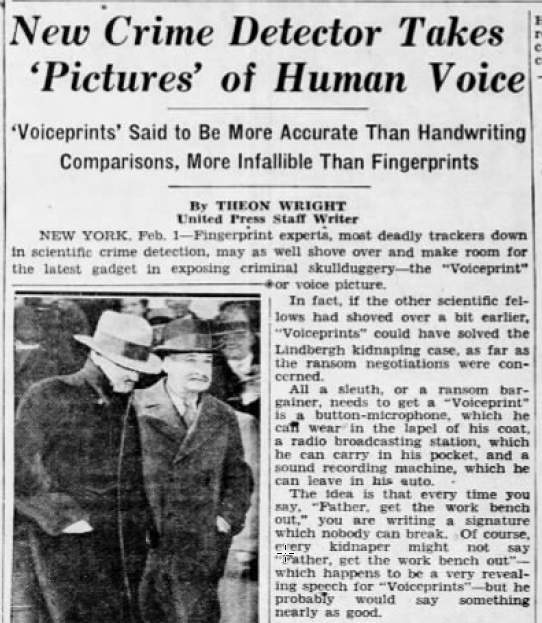
The Aural–Spectrographic Method (1960s–1970s)
Workflow:
- Unknown speech from wiretap / answering machine / surveillance
- “Known” speech recorded from a suspect (often using a matching script)
- Examiner uses critical listening + spectrogram comparison
- Output is an opinion about likelihood of same talker
Voiceprint Opinions (Classic Five-Point Scale)
- Positive identification
- Probable identification
- No decision
- Probable elimination
- Positive elimination
Reliability Questions and the NAS Warning (1970s)
- Studies challenged “spectrograms are unique and time-invariant”
- Raised risks of false identification and false elimination
- 1976: FBI asked National Academy of Sciences/NRC to review reliability
- 1979 panel: use in testimony only with clear explanation of limitations
Takeaway: Law Shapes Method
- Courts want process as much as results
- Documentation + transparency are not optional
- Methods trend toward measurable, reproducible evidence
II. Landmark Political & Criminal Investigations
When audio evidence changed national narratives
The Watergate Tapes (1974)

Watergate: The Break-In That Started It (June 17, 1972)
- Night guard Frank Wills noticed tape on a door latch
- Tape was removed and later found reapplied
- Police found five burglars in Democratic National Committee offices
- Set off the chain of events leading to Senate hearings and the tapes
Watergate: Discovery of the White House Tapes (1973)
- Senate Select Committee formed: Feb 7, 1973
- Public hearings increased pressure through spring 1973
- July 1973: aide Alexander Butterfield revealed a White House taping system
- Nixon initially resisted releasing tapes; subpoenas followed late 1973
Watergate: Where and How the Tapes Were Recorded
Installed during Nixon’s first term (conversations dating back to 1971)
Recording systems in:
- Oval Office and Cabinet Room (White House)
- President’s private office (Executive Office Building, EOB)
- Camp David
Watergate: The 18½-Minute Gap and the Advisory Panel
- June 20, 1972 Nixon–Haldeman tape: segment of interest became 18½ minutes of buzzing
- Suspected deliberate erase/record-over to destroy incriminating content
- Nov 1973: Judge John J. Sirica ordered forensic study
- Six outside experts formed a technical panel to assess authenticity
Watergate: Findings and Impact
- Forensics: multiple overlapping erasures detected
- Erasures made using a different recorder model than the original
- May 1974: panel reported erasures occurred after the original recording
- July 24, 1974: Supreme Court ordered release of tapes → “Smoking Gun”
- Aug 8, 1974: Nixon resigned amid impeachment threat
JFK Assassination Re-evaluation (1978–1980)
Source: Dallas Police dictabelt recording
Question: evidence of a second shooter?
JFK: The Crosstalk Correction
1980 National Academy of Sciences review used crosstalk analysis
Identified Sheriff Bill Decker: “Hold everything secure” on both channels
Conclusion: the “shots” occurred ~one minute after the assassination
Kent State Shooting Analysis (2010)
Source: digital copy of a 1970 student reel-to-reel tape
Modern enhancement revealed: “All right, prepare to fire!”
Gunshots followed ~two seconds later
Kent State: Additional Findings
- Detected four shots consistent with a .38-caliber revolver
- Occurred ~70 seconds before the main volley
- Supported theories of an earlier altercation
III. Hoaxes & High-Profile Cases
How audio misleads—and how analysts course-correct
The “Wearside Jack” Hoax (1978–2005)
Context: hunt for the Yorkshire Ripper
Hoaxer sent: cassette tape + three letters
Key feature: distinctive Wearside accent
Wearside Jack: Consequences and Resolution
- Investigation diverted to Sunderland for 18 months
- Police discounted Peter Sutcliffe (Yorkshire accent mismatch)
- 2005: DNA from envelope gum matched national database → conviction
Trayvon Martin Case (2012)
Question: whose screams are heard on a 911 call?
Expert: Edward Primeau concluded the voice was likely Martin’s
Corporate Fraud Case Study
Audio dismissed after:
- metadata analysis revealed timestamp inconsistencies
- speaker verification showed spliced segments from a different source
IV. Aviation Accident Investigations
Treating the cockpit as an acoustic sensor array
Cockpit Voice Recorders (CVR): What They Capture

USAir Flight 427 (1994)
CVR analysis focused on:
- crew reactions during sudden emergency
- structure-borne vibrations captured by ceiling microphone
Outcome: traced failure to rudder power control unit defect
Germanwings Flight 9525 (2015)
CVR revealed:
- copilot locked captain out of flight deck
- steady breathing indicated consciousness and intent throughout descent
Execuflight Flight 1526 (2015)
- No Flight Data Recorder available
- Investigators used CVR loop to measure turbine whine frequencies
- Inferred throttle settings and turbine speed before stall/crash
Cross-Cutting Evolution of Methods
- Analog era: physical media inspection (e.g., Bitter Patterns)
- Transition: auditory-phonetic expertise + documentation standards
- Digital era: metadata, waveform continuity, DSP, statistical inference
- Today: deepfakes and synthetic speech detection pressures
Practical Checklist for Any New Recording
- Preserve originals; document every transfer
- Assess integrity (metadata + signal continuity)
- Define the question (authenticity, enhancement, interpretation)
- Use validated methods; report uncertainty
- Keep work reproducible (settings, tools, logs)
Discussion Questions
- Which case most clearly shows method driving admissibility?
- Where do you see bias shaping interpretation?
- What is one “verification cross-check” you would add in each scenario?