Physics of Firearm Sound Signatures
DAD 498: Audio Forensics — Week 12
Today’s Topics
- Firearms and ammunition basics
- The muzzle blast
- Ballistic shock waves
- Other acoustic components
- Environmental acoustics
- Laboratory vs. forensic recordings
I. Firearms and Ammunition Basics
Understanding the source before the sound
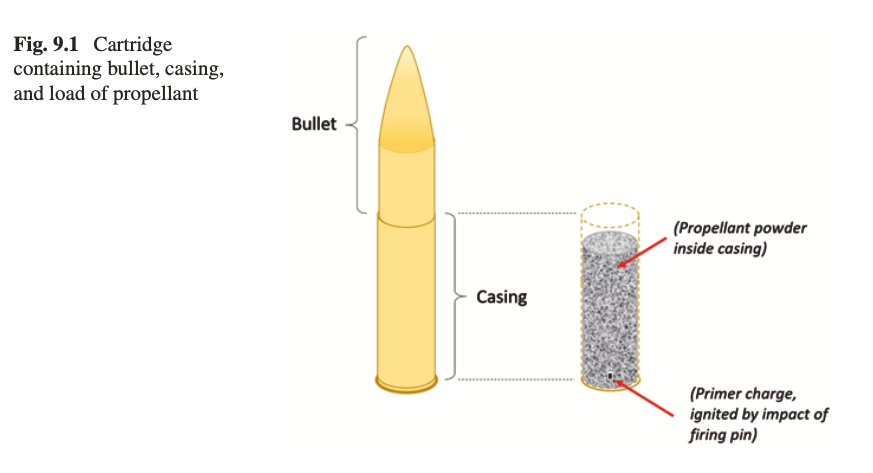
The Cartridge
- Casing — brass cylinder, holds propellant
- Primer — impact-sensitive ignition cap
- Propellant — gunpowder, becomes hot gas
- Bullet — the projectile itself
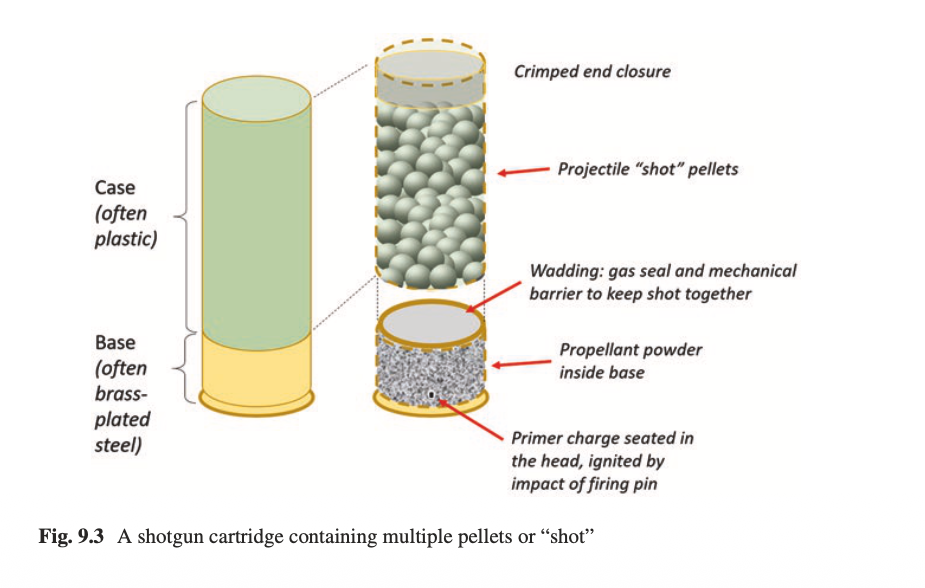
Shotgun Ammunition
- Plastic shell with metal base
- Contains primer and propellant
- Wadding seals gas behind the load
- Fires pellets (shot) or a single slug
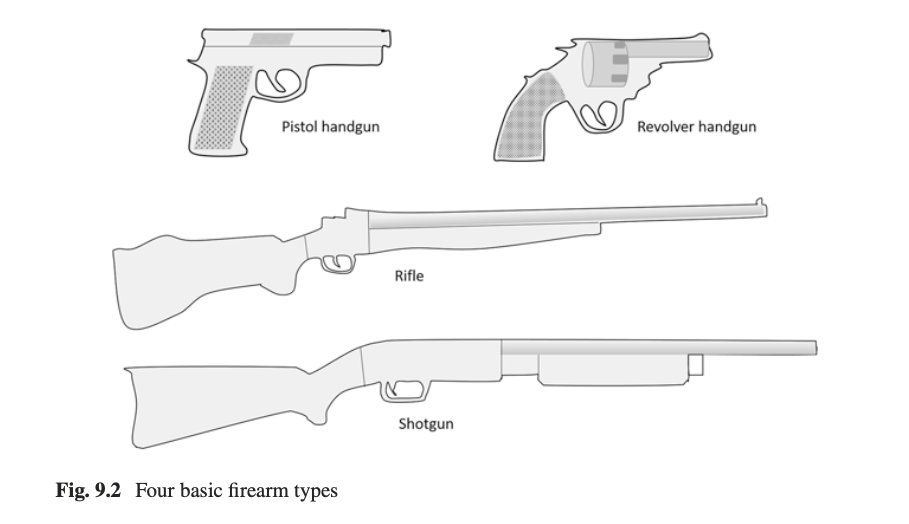
Firearm Types
- Pistol — Glock semiautomatic pistol; closed chamber, single barrel -
- Revolver — Ruger .357 Magnum revolver; rotating cylinder, multiple chambers -
- Rifle — AK-47 pattern rifle; long barrel with rifling grooves -
- Shotgun — Pump-action shotgun; smooth bore, large diameter -
What Is Caliber?
- Bullet diameter in inches or millimeters
- Same diameter, different cartridges
- More powder = more acoustic energy
- Helpful reference: Ammo Caliber Size Chart
Mechanical Actions
Percussion lock - hammer moves from half-cock to full-cock
Hear example at 1:53
Hear example at 1:53
Break-action - hinged barrel opens and locks closed
Hear shotgun breech at 5:07
Hear shotgun breech at 5:07
Pump-action - sliding fore-end
Hear example at 10:35
Hear example at 10:35
Lever-action - lever near trigger
Hear example at 12:02
Hear example at 12:02
Bolt-action - manual bolt handle
Hear example at 14:57
Hear example at 14:57
Semiautomatic - gas/recoil cycles the action
Hear pistol slide at 33:07
Hear pistol slide at 33:07

Acoustic Clues from Mechanics
- Firing pin strike (example video)
- Slide or bolt cycling - (example video)
- Spent casing ejection - (example video)
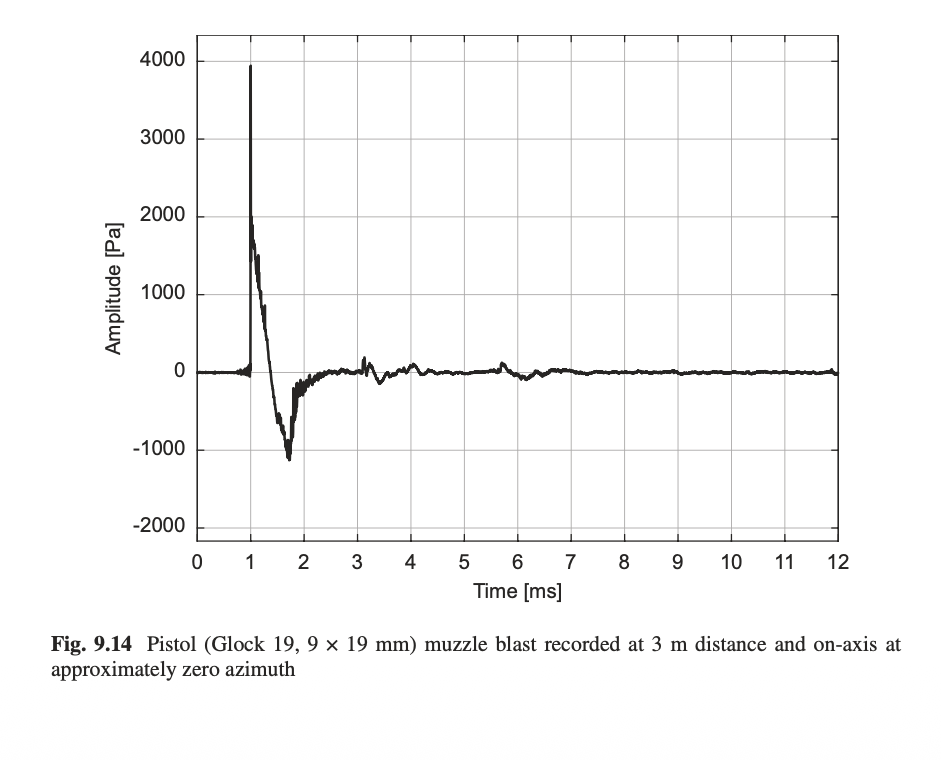
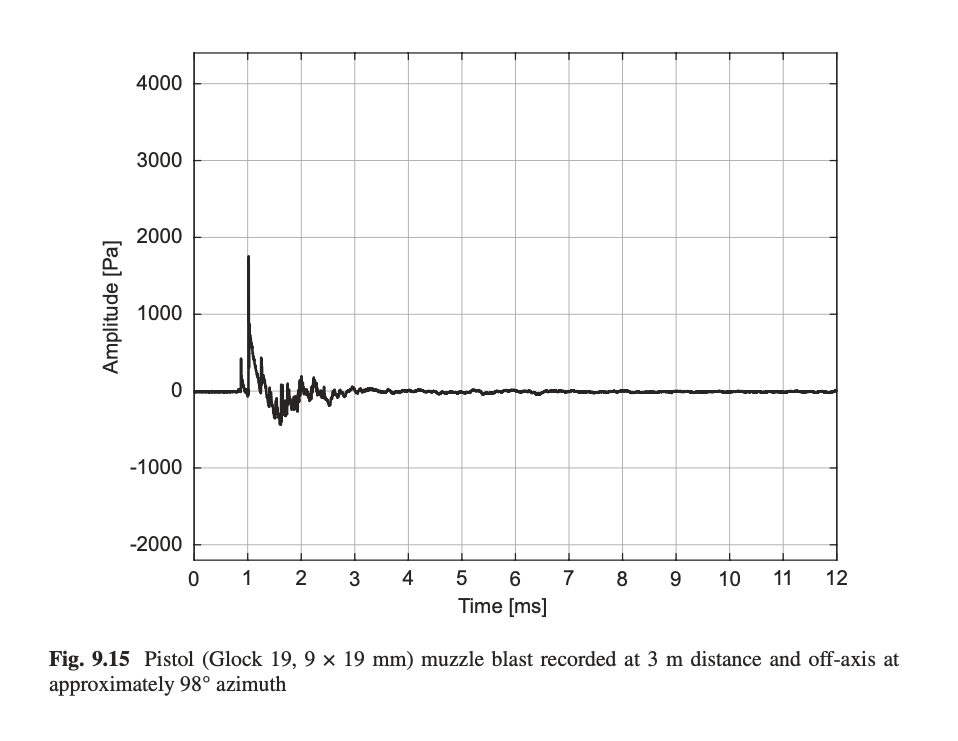
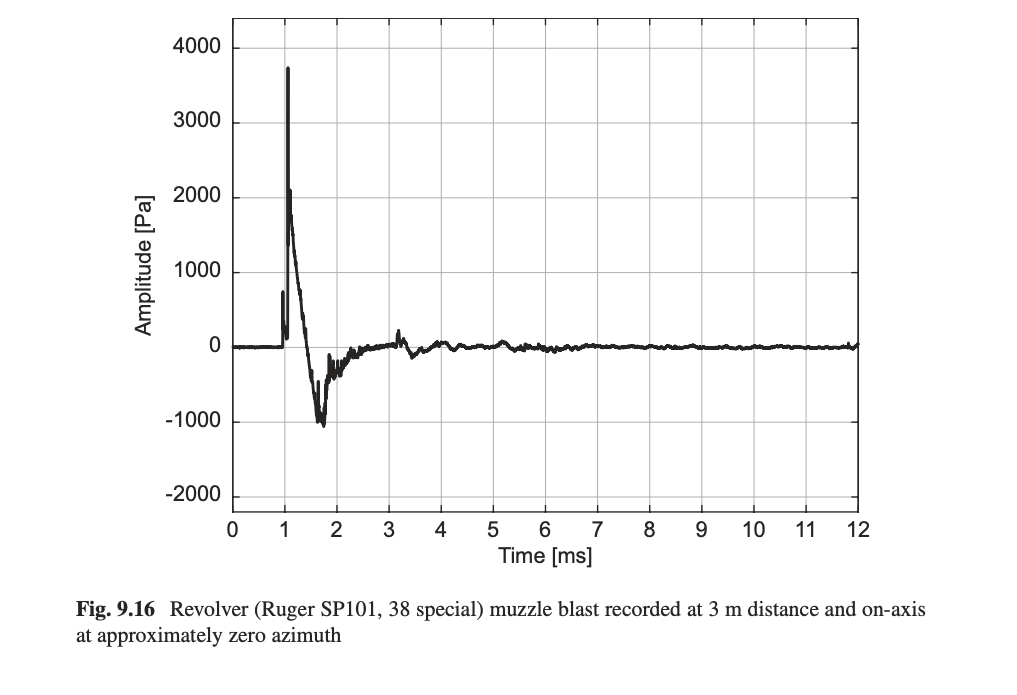
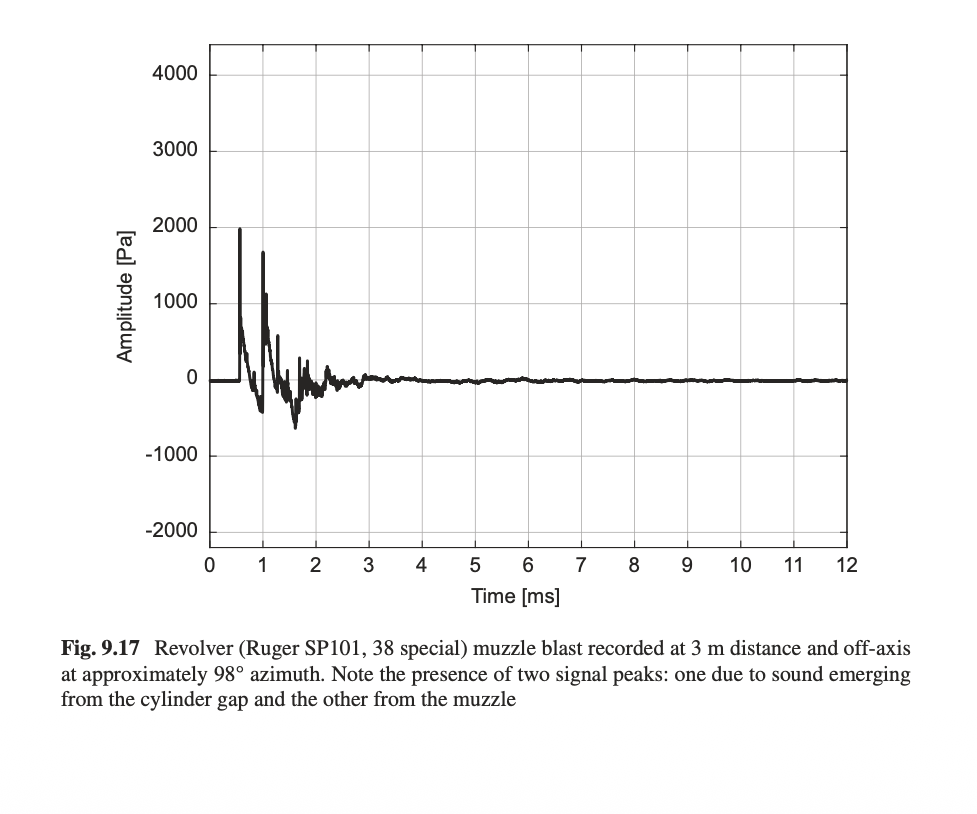
The Revolver Cylinder Gap
- Small gap between cylinder and barrel
- Hot gas leaks from this gap
- Creates a distinct pre-blast impulse
- Visible in off-axis recordings
Discussion
- Why might caliber alone be misleading?
- How could mechanical sounds help an examiner?
- What makes the revolver acoustically unique?
II. The Muzzle Blast
The primary “bang”
What Causes the Blast?
- Propellant ignites inside the casing
- Hot gas builds extreme pressure
- Gas exits the muzzle behind the bullet
- Rapid expansion creates a pressure wave
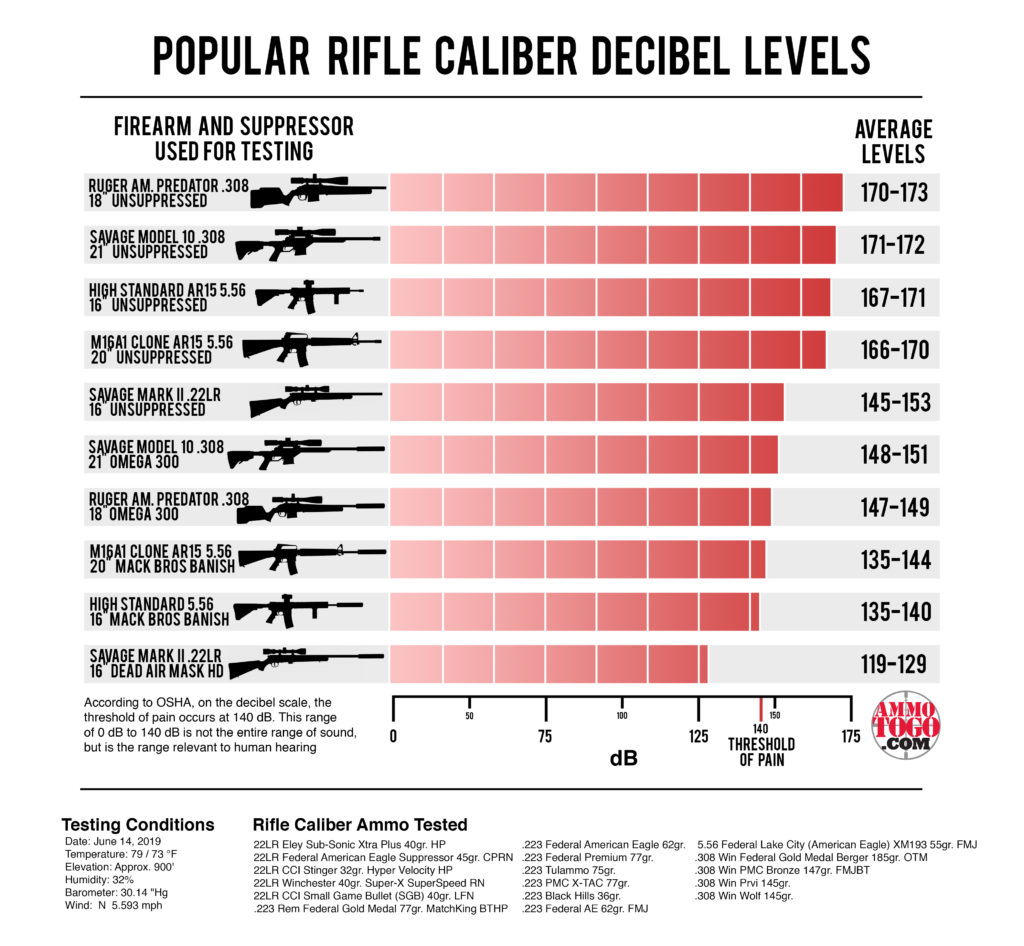
How Loud Is It?
- Peak levels exceed 150 dB SPL
- For reference: jet engine at 30m is ~140 dB
- Instant hearing damage without protection
- Overwhelms most consumer microphones
Duration: Surprisingly Brief
- True muzzle blast lasts only 1-3 ms
- That is 0.001 to 0.003 seconds
- Hollywood gunshots are heavily processed
- Echoes make it seem much longer
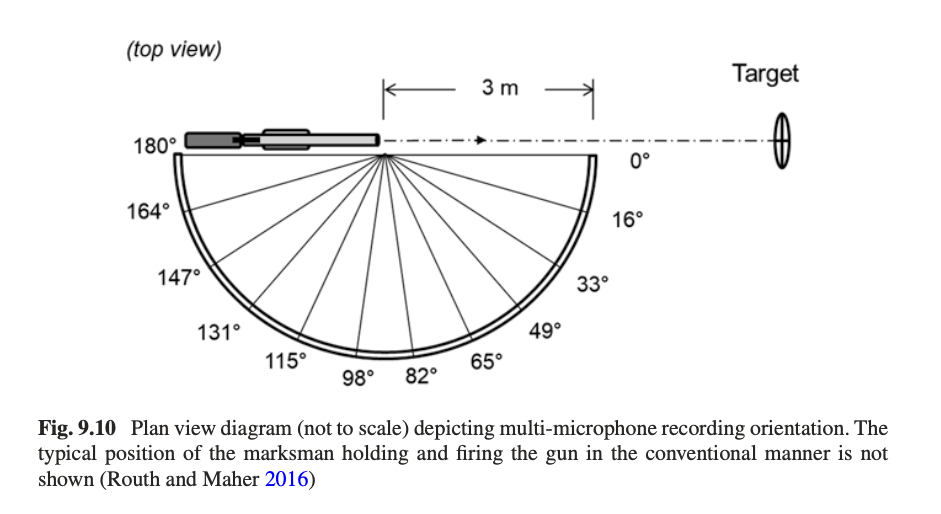
Directivity: Not a Point Source

The 20 dB Difference
- Most energy goes forward (barrel direction)
- Rear levels are ~20 dB lower
- Measured for a .308 rifle
- Critical for shooter location estimates


Discussion
- Why does the blast last only 1-3 ms?
- How does directivity affect witness accounts?
- What happens to a microphone at 150+ dB?
III. Ballistic Shock Waves
When bullets break the sound barrier
Supersonic vs. Subsonic
- Supersonic: bullet faster than sound (~343 m/s)
- Subsonic: bullet slower than sound
- Supersonic rounds produce a shock wave
- Subsonic rounds produce only muzzle blast
The Mach Number
- M = V / c (velocity / speed of sound)
- M > 1 means supersonic
- Higher M = narrower shock cone
- M = 1.8 → cone angle of 34 degrees
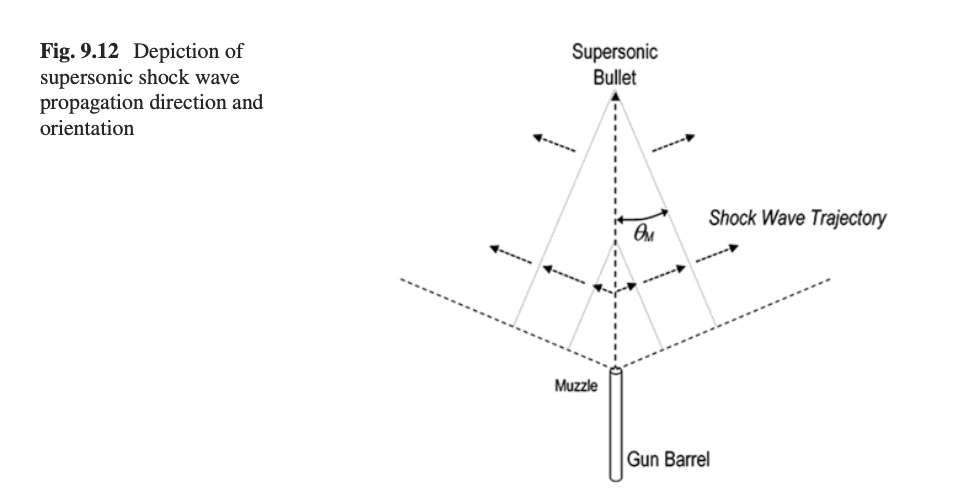
The Shock Wave Cone
- Cone trails behind the bullet
- Angle: theta = arcsin(1/M)
- M = 1.8 → 34 degree cone
- M = 3.5 → 16.6 degree cone
- Interactive Example:

The “N” Wave
- Distinctive pressure signature
- Abrupt onset, then abrupt offset
- Looks like the letter “N” in waveform
- Caused by nonlinear air propagation


What a Microphone Hears
Downrange mic: shock wave arrives first
Then the muzzle blast arrives later
Behind the shooter: only muzzle blast

Speed of Sound and Temperature
$$c = 331\sqrt{1 + \frac{T}{273}} \text{ m/s}$$
- T = temperature in Celsius
- At 20C: c is approximately 343 m/s
- Must account for this in forensic timing
Discussion
- Why does a downrange mic hear two events?
- How could temperature affect a forensic analysis?
- Why might subsonic ammo be forensically harder?
IV. Other Acoustic Components
Beyond the blast and the shock wave
Mechanical Action Sounds
- Trigger mechanism click
- Firing pin striking the primer
- Slide or bolt cycling
- Spent casing hitting the ground
Cylinder Gap: Timing Analysis
- Time between the two peaks varies
- Depends on barrel length and bullet speed
- Longer barrel = greater separation
- Can narrow down revolver model
Surface Vibration
- Gunshot shakes the ground and surfaces
- Vibration travels through solids
- At least 5x faster than airborne sound
- Can help resolve location ambiguities
The Complete Acoustic Signature
What Determines the Signature?
- Firearm type (pistol, revolver, rifle)
- Caliber and cartridge
- Barrel length
- Supersonic vs. subsonic ammunition
- Recording position relative to shooter
Discussion
- How could surface vibration help in casework?
- Why does position matter so much?
- What combination of clues identifies a revolver?
V. Environmental Acoustics
How the world reshapes the gunshot
Reflections and Echoes
- Sound bounces off buildings, ground, cars
- Each reflection is a delayed copy
- Multiple reflections overlap in time
- Creates a complex, extended waveform
From 3 ms to 700+ ms
- Source blast: 1-3 ms
- Urban recording: 700+ ms
- Overlapping reflections fill the gap
- A “pop” becomes a sustained “boom”
Reverberation
- Dense overlap of many reflections
- Characteristic decay pattern
- Depends on the space geometry
- Indoor vs. outdoor: very different
Absorption
- Surfaces absorb some sound energy
- Soft materials absorb more (grass, fabric)
- Hard materials reflect more (concrete, glass)
- Changes the spectral content over distance
Estimating Reflector Distance
- Time delay between direct and reflected sound
- Distance = (delay x speed of sound) / 2
- Divide by 2 because sound travels there and back
- Can identify nearby surfaces
Forensic Implications
- Environment is part of every recording
- Same gun sounds different in every location
- Reflections can obscure shot timing
- But reflections also carry information
Discussion
- Why is a 3 ms blast recorded as 700 ms?
- How might reflections help, not just hinder?
- Why does the same gun sound different indoors?
VI. Laboratory vs. Forensic Recordings
Pristine data meets messy reality
Laboratory Recordings
- Specialized mics (up to 500 kHz sample rate)
- Carefully leveled to avoid clipping
- Quasi-anechoic (echo-free) environments
- Capture true waveform shapes
Forensic Recordings
- Body cameras, surveillance, phones
- Clipped and distorted waveforms
- Heavy background noise
- Dense reverberation
The Clipping Problem
- Gunshot pressure overloads the microphone
- Waveform peaks are chopped flat
- True amplitude information is lost
- Non-linear distortion adds false frequencies
Bridging the Gap
- Lab data provides reference signatures
- Forensic recordings require interpretation
- Pattern matching, not exact comparison
- Experience and methodology matter
Discussion
- Why can’t we just use better mics at crime scenes?
- What information survives clipping?
- How do lab recordings help forensic work?
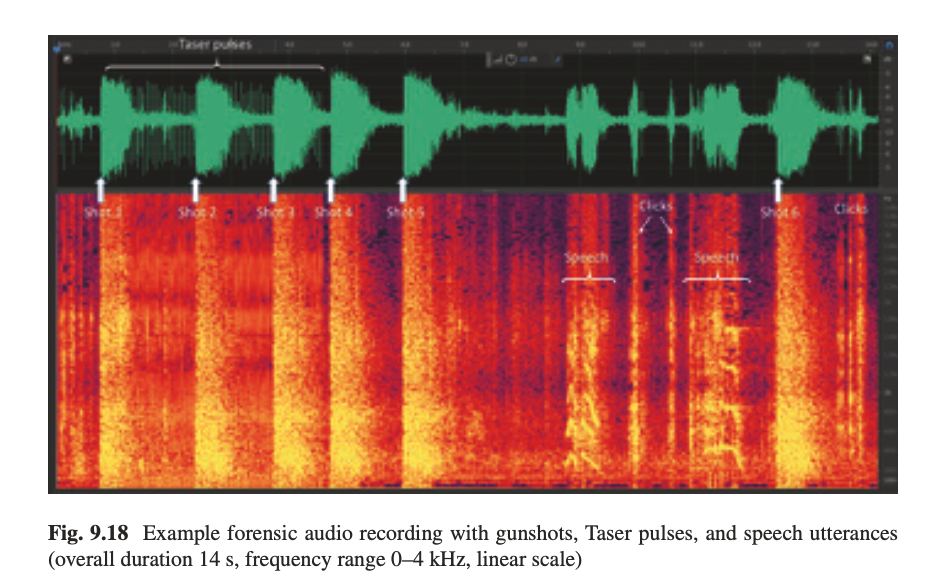
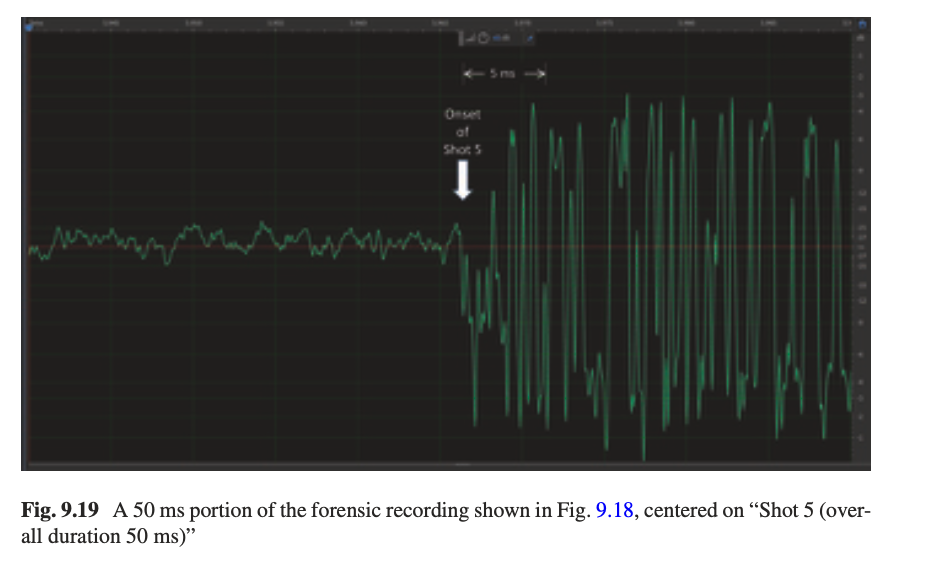
VII. Forensic Recording Example 1
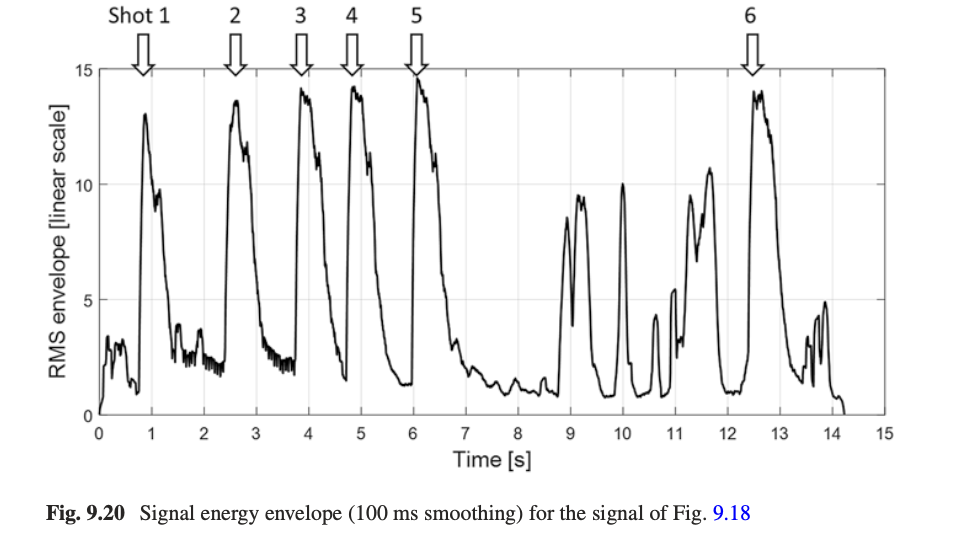
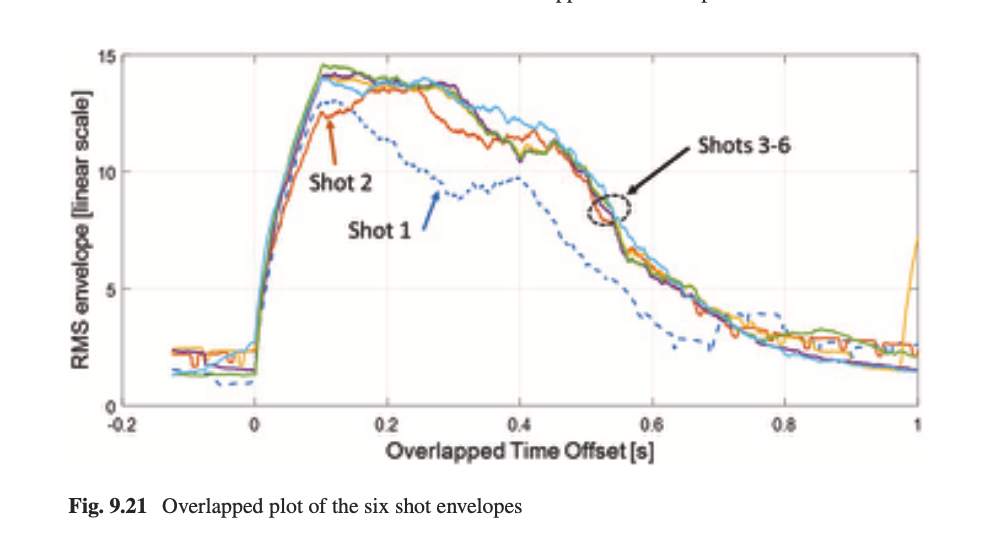
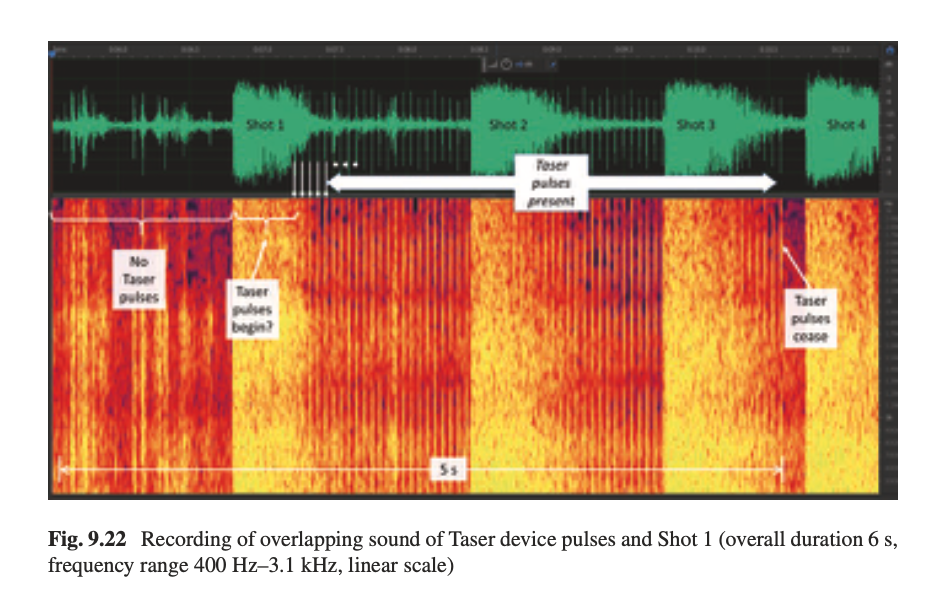
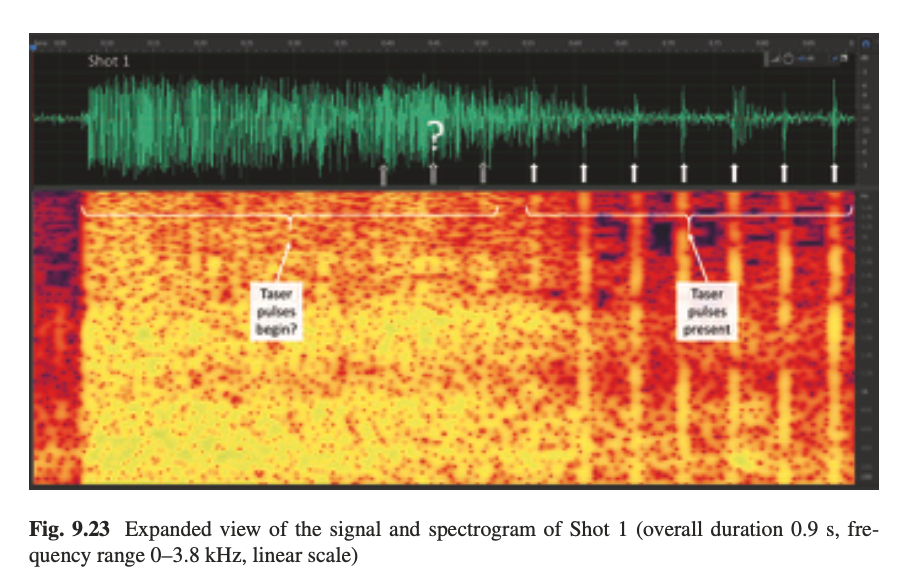
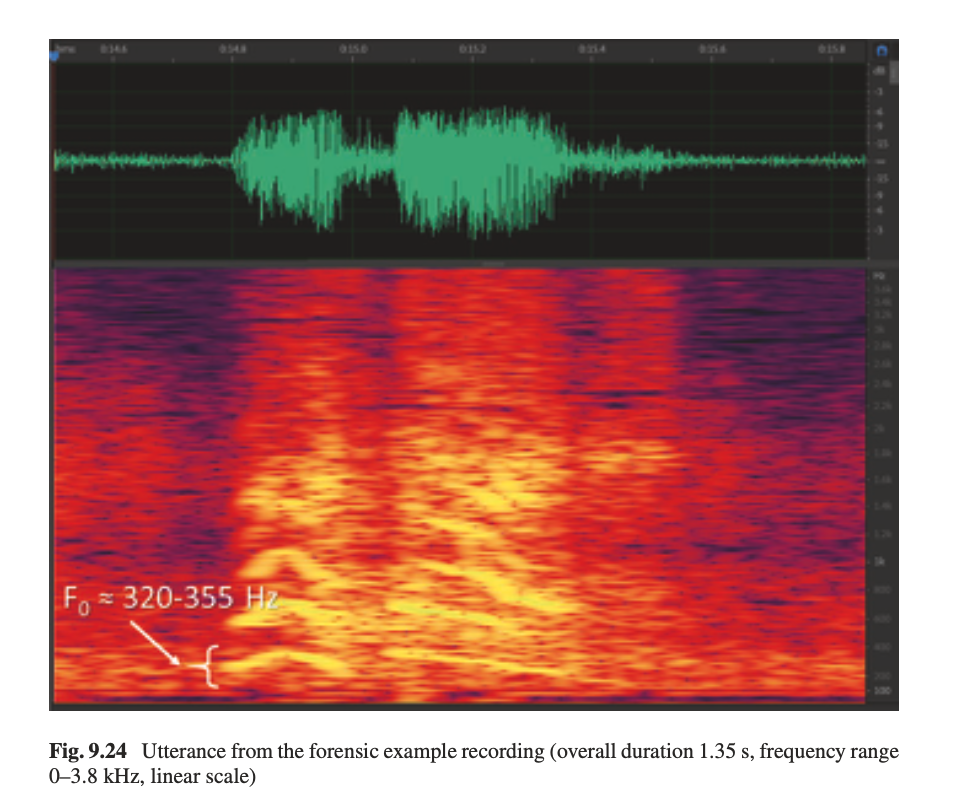
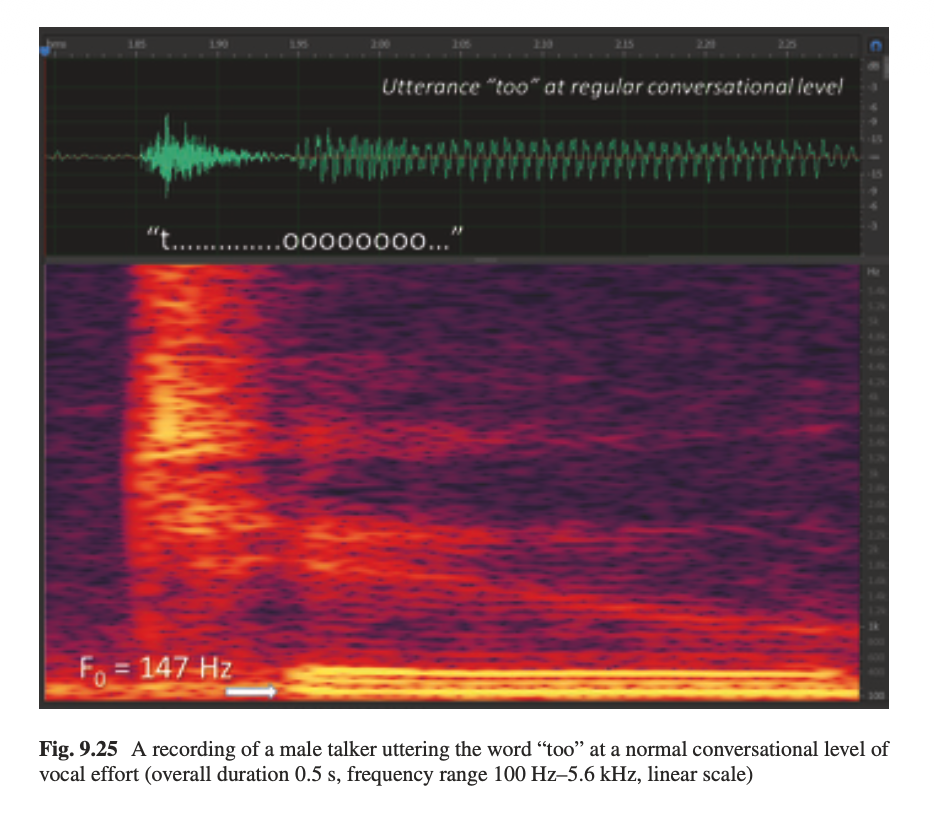
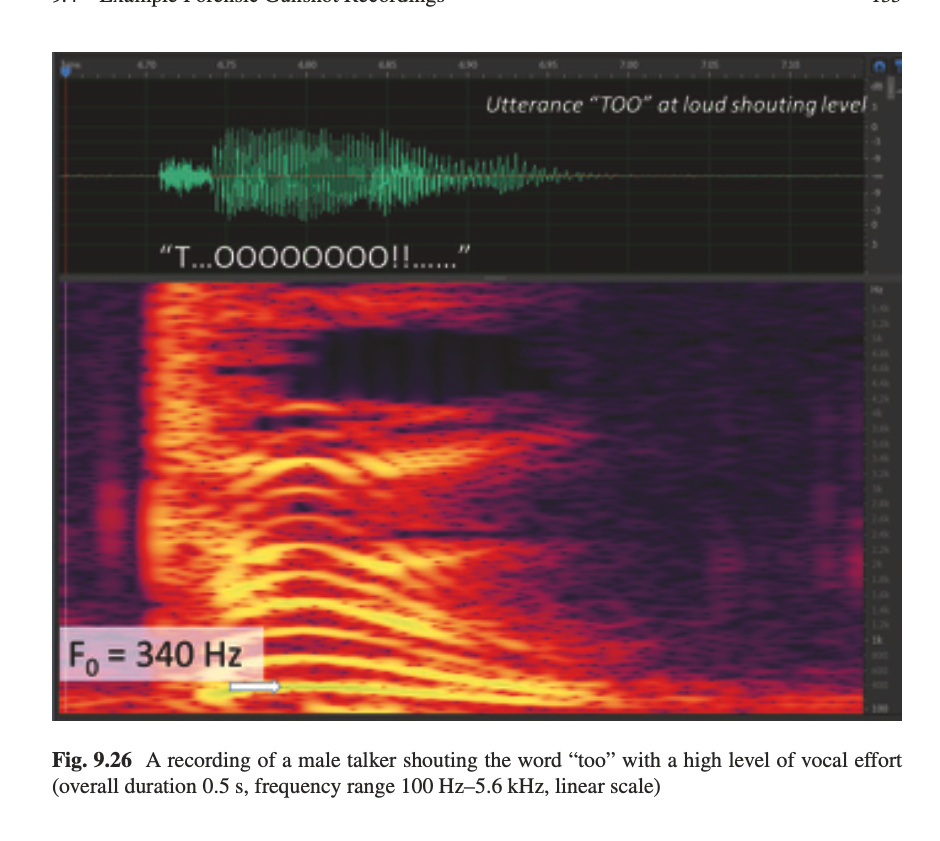
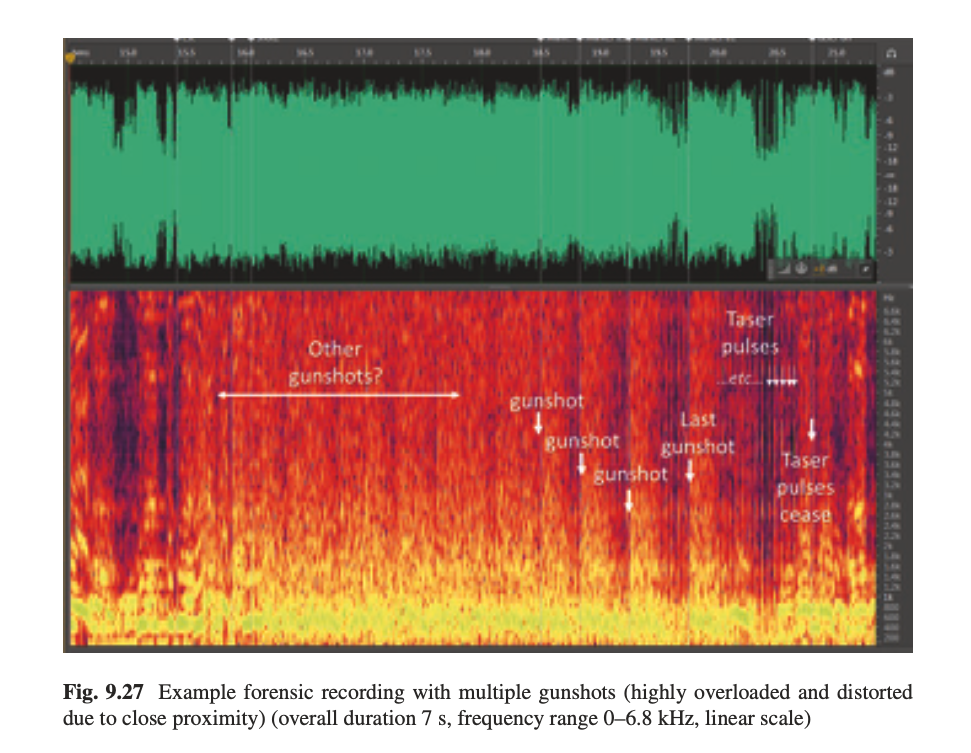
Taser, gunshots, and speech on one recording
Discussion
- How do overlaid envelopes help identify a weapon?
- Why might Taser timing matter legally?
- What are the risks of pitch-based speaker ID?
VIII. Forensic Recording Example 2
Synchronizing multiple devices
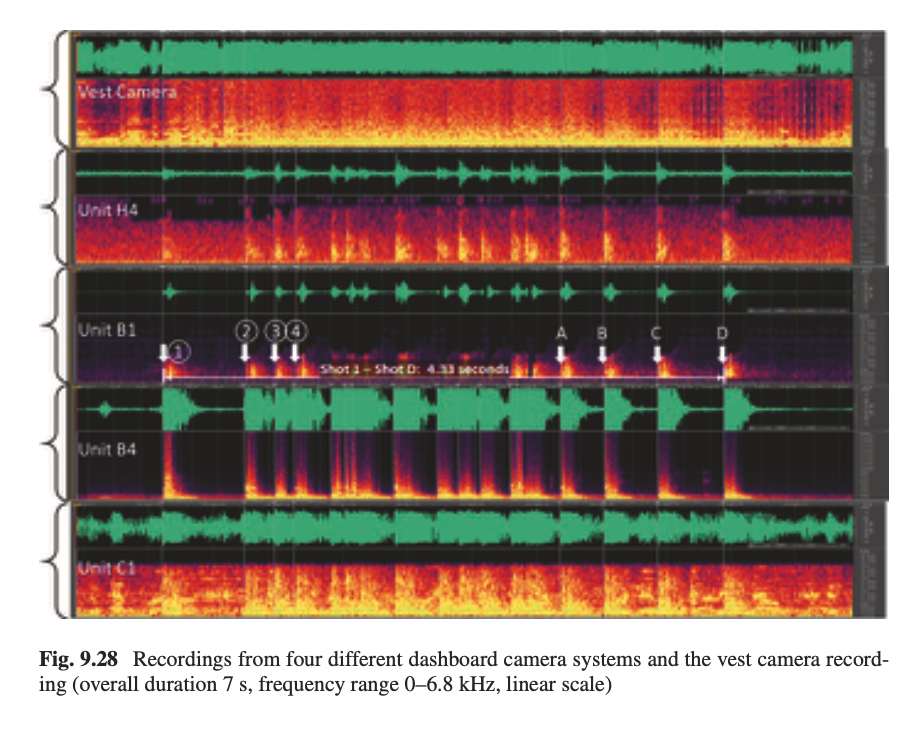
Discussion
- Why are distant recordings sometimes more useful?
- What makes a good synchronization reference?
- How does multi-device analysis strengthen a case?
Key Takeaways
- Gunshots have multiple acoustic components
- Muzzle blast is brief (1-3 ms) and directional
- Supersonic bullets create N-wave shock waves
- Environment transforms the recorded signal
Summary
- Next week: complex shooting incidents
- Taser analysis and case studies
- Applying these physics to real casework
- Read: Maher, Ch. 9 (continued)