Forensic Interpretation
Forensic Audio Analysis — Week 11
Today’s Topics
- Overview of forensic interpretation
- Scientific integrity and the NAS Report
- Case study: Gunshot localization (TDOA)
- Case study: Doppler effect and speed estimation
- Case study: Distance estimation from sound level
- Likelihood ratios in forensic audio
I. What Is Forensic Interpretation?
Three Pillars of Audio Forensics
- Authentication — objective measurement
- Enhancement — partly subjective processing
- Interpretation — objective + subjective judgment
The Interpretation Challenge
- Strives for objectivity
- Relies on examiner experience
- Requires induction and contextual reasoning
- Findings may influence legal outcomes
Discussion
- Where is the line between objective measurement and subjective interpretation?
- Can forensic audio ever be fully objective? Should it try to be?
- How should an expert communicate uncertainty to a jury?
II. Scientific Integrity
Transparency and Reproducibility
- Methods must be explainable
- Results must be verifiable by others
- No “black box” or proprietary claims
Ethical Concerns
- Reject claims of “golden ears”
- No secret analytical techniques
- Lack of transparency undermines the field
The NAS Report (2009)
Strengthening Forensic Science in the United States: A Path Forward
NAS: Two Key Questions
- Is the method scientifically valid and reliable?
- How much depends on subjective judgment?
Discussion
- Have you encountered “black box” claims in other forensic fields?
- How does cognitive bias affect forensic analysis?
- What safeguards could reduce bias in audio forensics?
III. Measurement Fundamentals
Four Measurement Domains
- Time — when events occur
- Frequency — pitch and spectral content
- Amplitude — loudness and signal level
- Spectrum — frequency distribution over time
Precision vs. Accuracy
- Precision — repeatability and resolution
- Accuracy — correctness relative to a standard
Discussion
- Why is it important to distinguish precision from accuracy in court testimony?
- What happens if you report a precise measurement that isn’t accurate?
- How would you explain measurement uncertainty to a non-technical jury?
IV. Case Study: Gunshot Localization
The Scenario
- Two police cruisers record gunshots
- Key questions:
- Where did the shots originate?
- Same or different firearm(s)?
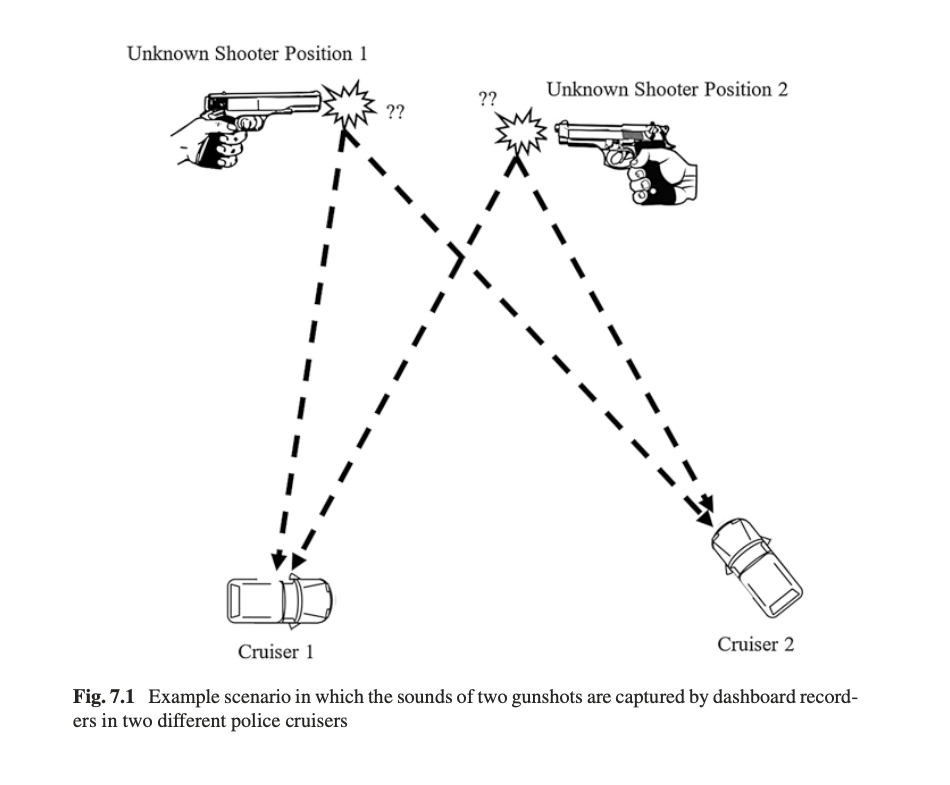
TDOA: The Core Idea
- Sound travels at a known speed
- Different distances = different arrival times
- Time difference → distance difference
Speed of Sound
$$c = 331.45\sqrt{1 + \frac{T}{273}}$$
- c = speed of sound (m/s)
- T = temperature in Celsius
- ~343 m/s at 20°C
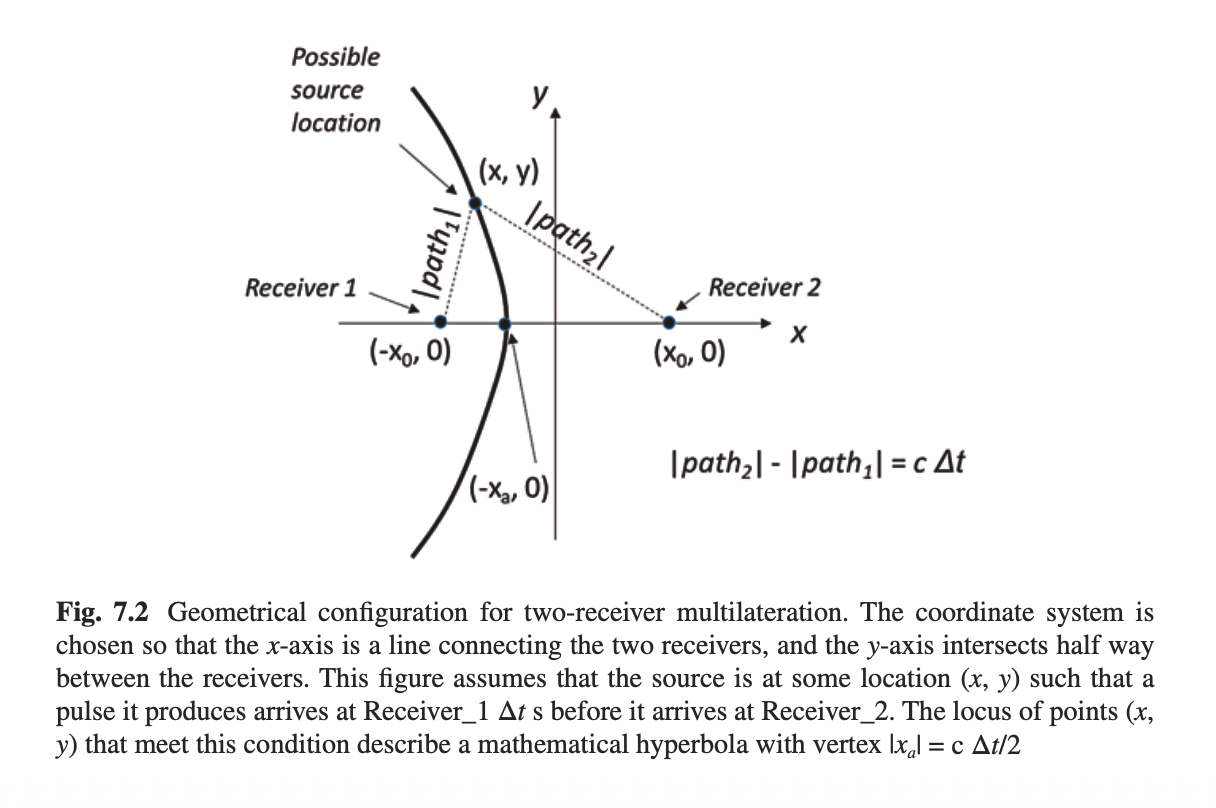
The Hyperbolic Locus
- Two receivers → one TDOA measurement
- Defines a hyperbola of possible locations
- Source lies somewhere on that curve
Multilateration
- Third receiver → second hyperbola
- Intersection = source location
- More receivers → more confidence
Sources of Uncertainty
- Unsynchronized recordings
- Vehicle position estimation errors
- Speed of sound variability
- Event alignment ambiguity
Gunshot Acoustic Components
- Muzzle blast — spherical propagation
- Ballistic shockwave — conical “N-wave”
- Mach angle: $\theta = \arcsin\left(\frac{c}{v}\right)$
Discussion
- Why is multilateration preferred over triangulation for gunshot localization?
- What real-world factors would make TDOA unreliable in an urban setting?
- How would you explain a hyperbolic locus to a jury?
V. Case Study: Doppler Effect
The Scenario
- 911 call captures a truck horn before a crash
- Can we determine the truck’s speed?
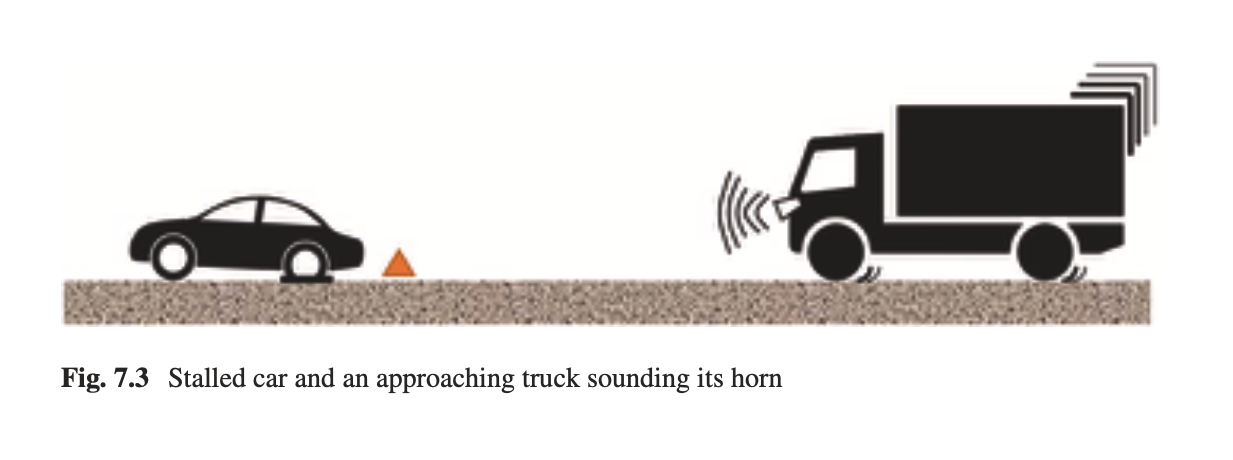
Doppler Effect
- Approaching source → higher frequency
- Receding source → lower frequency
- Frequency shift reveals velocity
The Doppler Equation
$$f = f_0 \cdot \frac{c}{c - v}$$
- f = observed frequency
- f₀ = source frequency at rest
- c = speed of sound
- v = source velocity
Solving the Case
- Horn at rest: 295 Hz
- Observed in recording: 329 Hz
- Temperature: 17°C → c = 341.5 m/s
- Result: ~35.3 m/s ≈ 79 mph
Sources of Uncertainty
- Frequency estimation accuracy
- Sampling rate errors
- Air temperature variation
- Non-radial motion (angle of approach)
Discussion
- How would a 2.4% sampling rate error affect a court case about speeding?
- What other scenarios could Doppler analysis help investigate?
- Why must the approach angle be considered?
VI. Case Study: Distance Estimation
The Scenario
- Dispute over distance of a shouted threat
- Competing claims: 1 meter vs. 8+ meters
- Recording exists from a consumer device
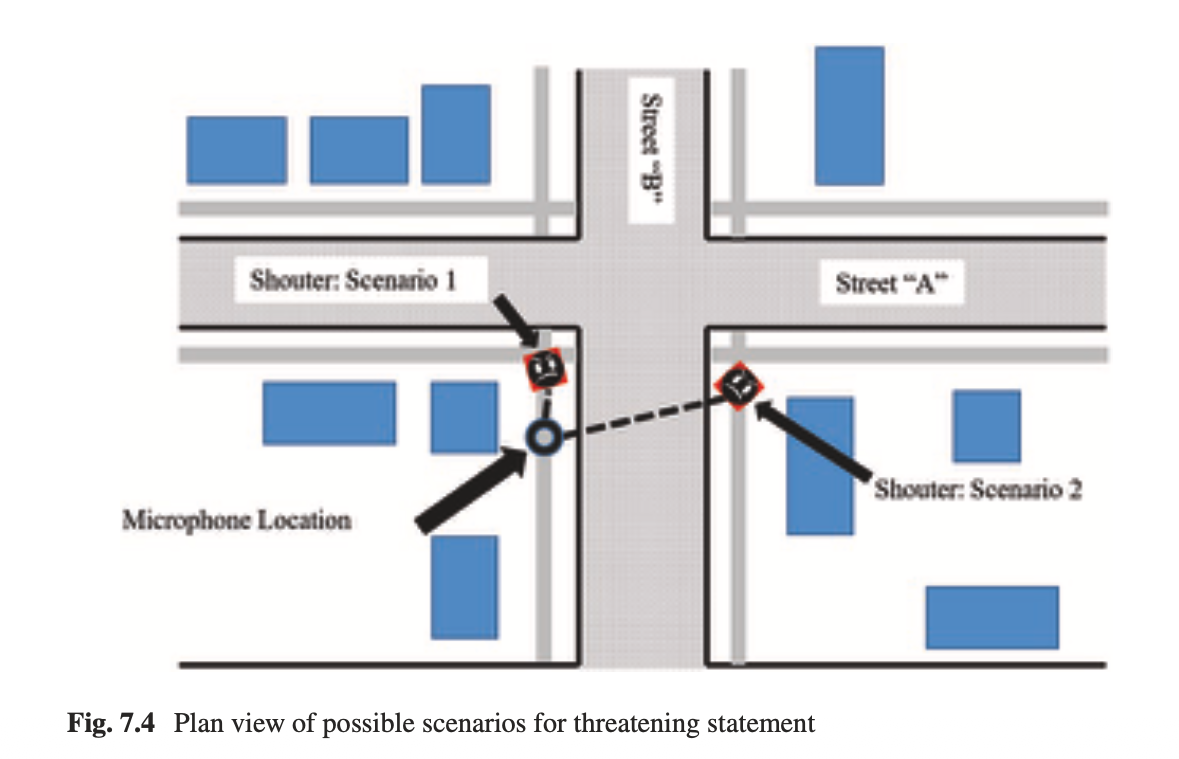
Spherical Spreading Law
- Sound intensity follows inverse square law
- ~6 dB loss per doubling of distance
- 1 m to 8 m ≈ 18 dB difference
Complicating Factors
- Unknown vocal intensity
- Microphone characteristics
- Automatic Gain Control (AGC)
- Reflections and reverberation
Recommended Approach
- Controlled reconstruction experiment
- Same device, same location
- Documented procedure (video)
- Compare reconstruction to original
Discussion
- Why can’t we simply measure the recorded volume to determine distance?
- When might a reconstruction experiment not be feasible?
- How should an expert present inconclusive distance findings?
VII. Likelihood Ratios
The Concept
$$LR = \frac{P(\text{evidence} \mid H_p)}{P(\text{evidence} \mid H_d)}$$
- H_p = prosecution hypothesis
- H_d = defense hypothesis
DNA as the Benchmark
- Highly discriminative patterns
- Quantifiable probabilities
- LRs in the quadrillions
Application to Audio
- Possible but difficult
- Speech signals are inherently variable
- Dependent on recording conditions
- Limited statistical models
Challenges
- Estimating probability of a match
- Building relevant population databases
- Variability in recording conditions
- Limited adoption in practice
Discussion
- Why are likelihood ratios preferable to “match/no match” conclusions?
- What makes audio LRs harder than DNA LRs?
- How might an expert explain a likelihood ratio to a jury?
Key Takeaways
- Interpretation = objective measurement + subjective reasoning
- Transparency and reproducibility are non-negotiable
- Uncertainty must be explicitly identified and reported
- Contextual integration with other evidence is essential
Summary
- Forensic interpretation combines physics with judgment
- TDOA, Doppler, and spreading laws are key tools
- Every measurement carries uncertainty
- Likelihood ratios are the future of evidence evaluation